
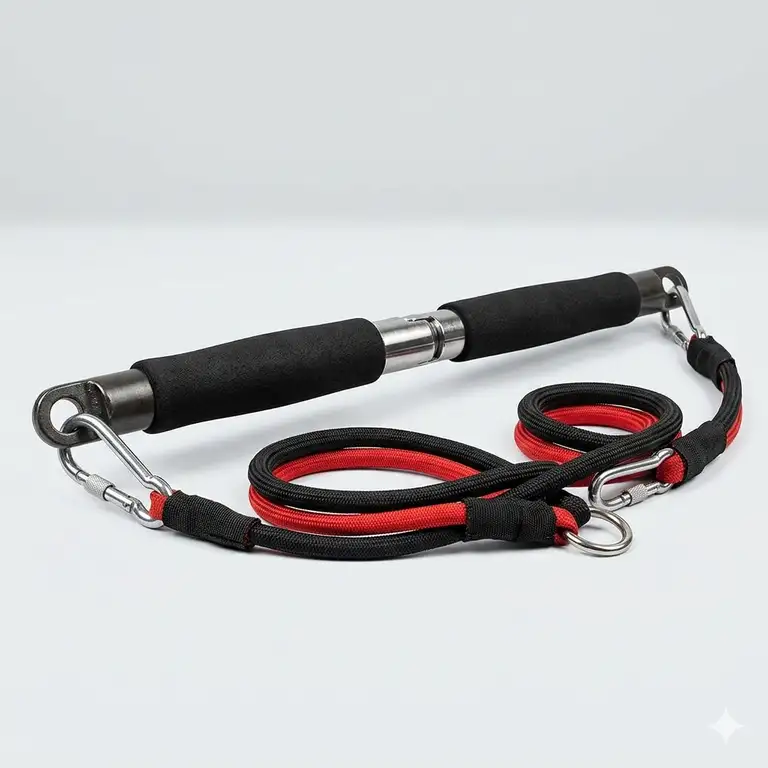
An exercise resistance bar is a specialized fitness tool designed to bridge the gap between traditional barbell training and portable resistance band workouts. It consists of a rigid bar—typically made of steel, aluminum, or high-strength polymers—equipped with heavy-duty attachment points at both ends. These points connect to elastic resistance bands, allowing you to perform compound movements like squats, chest presses, and deadlifts. Unlike static weights, these bars utilize variable resistance, meaning the tension increases as the band stretches, reaching its peak at the top of your range of motion. This unique loading profile is highly effective for building explosive power and muscle hypertrophy while placing significantly less stress on your joints compared to iron plates.
In the fitness landscape of 2026, the exercise resistance bar has evolved from a niche travel accessory into a legitimate cornerstone of home gym setups. With advancements in metallurgical engineering and latex durability, today’s bars can handle hundreds of pounds of tension without flexing or snapping. Whether you are a frequent traveler looking to maintain muscle mass on the road or a home-gym enthusiast trying to save space, understanding how to leverage this tool is essential. It isn’t just a “portable gym”; it is a sophisticated load-management system that challenges your muscles in ways gravity-dependent weights simply cannot.
Quick Comparison: Top Exercise Resistance Bar Models for 2026
| Product Name | Best For | Weight Capacity | Portability | Price Range |
| X3 Bar Elite | Hypertrophy & Power | 600 lbs+ | High | Around $500 |
| INNSTAR Bar | Versatility & Travel | 300 lbs | Moderate | $60–$80 |
| BodyBoss 2.0 | Total Home Gym Setup | 150 lbs | Low (Base included) | $150–$180 |
| GIBBON Heavy Duty | Heavy Lifters | 800 lbs | Moderate | $90–$110 |
| TheFitLife Kit | Beginners/Rehab | 100 lbs | Extreme | $40–$60 |
Looking at the comparison above, the X3 Bar Elite remains the undisputed king for those prioritizing muscle growth, but its premium price point reflects its specialized engineering. For the average user, the INNSTAR Bar provides the best balance of durability and cost, handling enough tension for most intermediate lifters. If you are just starting out or recovering from an injury, TheFitLife Kit offers a low-barrier entry point, though you will likely outgrow its resistance capacity within six months of consistent training.
💬 Just one click — help others make better buying decisions too! 😊
[addtoany]
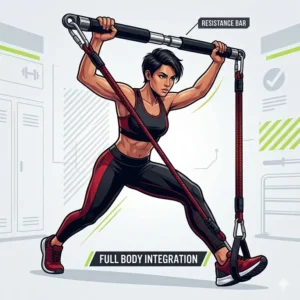
Top 5 Exercise Resistance Bar Models: Expert Analysis
1. The X3 Bar Elite: The Gold Standard for Variable Resistance
The X3 Bar Elite isn’t just a bar; it’s a complete physiological system designed by Dr. John Jaquish to maximize growth hormone production through heavy variable loading. The bar itself is crafted from high-grade alloy steel with a knurling pattern that rivals professional Olympic barbells.
Key specifications include a 12-inch ground plate and heavy-duty latex bands that can produce over 600 lbs of peak force. In practical terms, this means you can perform “heavy” deadlifts in your living room without a thousand dollars’ worth of iron plates. The included ground plate is crucial—it protects your ankles and feet from the massive compression forces generated by the elite bands, a safety feature many cheaper bars ignore.
In my experience, the X3 Bar is for the trainee who is serious about replacing the commercial gym entirely. What most buyers overlook is the “tapered” nature of the workout; you will find you can lift much more than your usual barbell weight because the load is lightest where your joints are most vulnerable.
-
Pros: Professional-grade steel construction; includes a necessary ground plate; supports massive resistance levels.
-
Cons: Very expensive; steep learning curve for proper form.
-
Price Range: Around $500
-
Value Verdict: The best ROI for serious lifters who want to gain size without the joint wear of heavy iron.
2. INNSTAR Resistance Band Bar: The All-Rounder
The INNSTAR Resistance Band Bar is a 38-inch detachable bar that focuses on comfort and versatility. It features a thick foam padding that prevents the bar from digging into your upper back during high-rep squats or lunges.
The bar breaks down into two pieces, making it the perfect companion for checked luggage. It supports up to 300 lbs of tension, which is plenty for 90% of home users. Unlike the X3, this bar utilizes a “sleeve-protected” band system, which prevents the latex from snapping or wearing down against the floor or your shoes—a massive safety win for long-term use.
This product is ideal for the “weekend warrior” or the professional who spends half their life in hotel rooms. The 38-inch length is a sweet spot; it’s wide enough for snatch-grip rows but short enough to fit in a standard suitcase when disassembled.
-
Pros: Excellent portability; comfortable foam padding; sleeve-protected bands for safety.
-
Cons: Connection point can develop a slight wiggle over time; foam may wear down with heavy use.
-
Price Range: Around $60–$80
-
Value Verdict: The most practical choice for the average person who wants a solid workout without a massive investment.
3. BodyBoss Home Gym 2.0: The Complete Ecosystem
The BodyBoss Home Gym 2.0 takes the exercise resistance bar and anchors it to a foldable base plate. This setup allows for unique angles of resistance that a standalone bar cannot easily replicate, such as lateral raises or simulated cable crossovers.
The bar is lightweight and features 360-degree rotating clips. These clips are a game-changer because they prevent the bands from tangling or binding during rotational movements like woodchoppers. However, the base is the real star here; it allows you to shorten the bands easily to increase tension without needing to buy a whole new set.
If you’re someone who gets bored easily, the BodyBoss is your best bet. The sheer variety of exercises—over 300 according to the manufacturer—keeps things fresh. Just be aware that the maximum resistance is lower than the steel-bar competitors, peaking at around 150 lbs.
-
Pros: Incredible exercise variety; rotating clips prevent band tangling; very stable base plate.
-
Cons: Lower resistance ceiling; the plastic base feels less “premium” than steel bars.
-
Price Range: Around $150–$180
-
Value Verdict: A fantastic “gym in a box” for those who prioritize variety and aerobic-style strength training.
4. GIBBON Heavy Duty Bar: Built for the Powerlifter
The GIBBON Heavy Duty Bar is designed for one thing: raw strength. With a staggering 800 lb weight capacity, this bar is thick, heavy, and features industrial-grade bearings in the end caps.
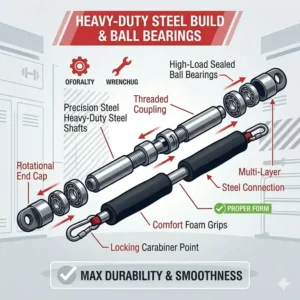
The inclusion of ball bearings in the attachment points is what sets this apart. As you curl or press, the bands rotate independently of the bar, ensuring that the torque is applied to your muscles and not your wrists. This is a subtle engineering detail that makes a massive difference when you’re working with 100+ lbs of tension.
I recommend this for former powerlifters or anyone transitioning from heavy free weights. The bar has a 1.5-inch diameter, which is thicker than standard Olympic bars, providing a “fat bar” training effect that builds significant grip and forearm strength.
-
Pros: Massive 800 lb capacity; ball-bearing swivel points; thick diameter for grip training.
-
Cons: No bands included in the base price; the bar itself is quite heavy for travel.
-
Price Range: Around $90–$110
-
Value Verdict: The most durable standalone bar on the market for those who already own a collection of heavy resistance bands.
5. TheFitLife Exercise Resistance Bar: The Budget Starter
For those dipping their toes into the world of resistance training, TheFitLife Exercise Resistance Bar offers an accessible, lightweight kit that gets the job done without the bells and whistles of the elite models.
It is a three-section bar, which makes it the most compact on this list. While it is made of aluminum rather than steel, it is surprisingly sturdy for light to moderate loads. The kit usually comes with a set of fabric-covered bands, which are much more comfortable against the skin than raw latex.
This is the “rehab and tone” choice. It’s perfect for seniors or those coming off a long fitness hiatus. The resistance isn’t going to turn you into a bodybuilder, but for maintaining bone density and functional mobility, it is an excellent, low-cost tool.
-
Pros: Highly affordable; very compact 3-piece design; great for high-rep toning.
-
Cons: Not suitable for heavy strength building; aluminum will flex under high tension.
-
Price Range: Around $40–$60
-
Value Verdict: An unbeatable entry-level option for those on a strict budget or with modest fitness goals.
✨ Don’t Miss These Exclusive Deals!
🔍 Take your fitness journey to the next level with these carefully selected products. Click on any highlighted item to check current pricing and availability. These tools will help you create authentic results your family will love!
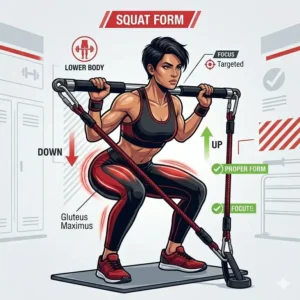
The 30-Day Transition: From Heavy Iron to Resistance Bars
Transitioning from a traditional gym to a home setup featuring an exercise resistance bar is more of a mental shift than a physical one. Most people fail because they try to use the bar exactly like a barbell, ignoring the unique physics of elastic tension. In my experience, the first two weeks are usually spent in a state of “unstable” frustration. Because the bands don’t have inertia like a 45-pound plate, your stabilizer muscles have to work twice as hard to keep the bar on a steady path.
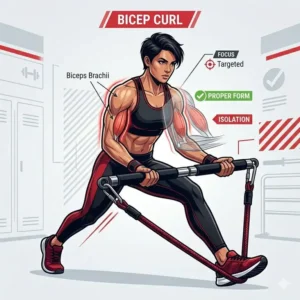
To succeed, you must embrace the “time under tension” principle. In the traditional gym, the hardest part of a bicep curl is the middle; at the top, the weight is basically resting on your skeletal structure. With an exercise resistance bar, the top of the movement is the most difficult. This is where the magic happens. By slowing down the “negative” (the lowering phase) and holding the peak contraction for two seconds, you trigger metabolic stress that traditional weights can’t match.
For the first 30 days, ignore the “equivalent weight” numbers on the bands. Focus instead on the “burn.” If you can’t hit 15 reps with perfect form, the resistance is too high. By day 20, you’ll notice a “density” in your muscles—a result of the constant tension that never lets the muscle fibers relax during a set. According to research on elastic resistance, this form of training is just as effective for hypertrophy as free weights when taken to failure.
Real-World Scenario: The “Digital Nomad” Workout Strategy
Imagine you are a consultant traveling through the USA, jumping between hotels in Chicago, Austin, and Seattle. You have zero time for finding a local gym, and hotel fitness centers are notoriously hit-or-miss. This is where the exercise resistance bar becomes a literal life-saver for your physique.
The Strategy:
-
The Gear: You pack the INNSTAR Bar (disassembled) and three varying levels of bands in your carry-on.
-
The Setup: Use the door anchor (usually included in these kits) to turn the hotel bathroom door into a high-pulley station for tricep extensions and face pulls.
-
The Workout: Perform a “Push/Pull/Legs” split. For legs, use the bar for “Good Mornings” and front squats. Since you can’t carry a 300 lb squat rack, you increase the difficulty by doing single-leg Bulgarian split squats with the bar.
The beauty of this scenario is the lack of “friction.” You don’t have to pack a bag, drive to a gym, or wait for a rack. You roll out of bed, assemble the bar in 30 seconds, and get to work. For the person whose life is unpredictable, the exercise resistance bar offers the one thing the gym can’t: absolute consistency. It removes every excuse. If you have six square feet of floor space, you have a world-class training facility.

How to Choose the Right Exercise Resistance Bar
Selecting an exercise resistance bar is not a “one size fits all” decision. If you buy a bar that is too light for your strength level, you’ll be bored in a week; buy one that’s too cumbersome, and it will collect dust under your bed. Here is the expert framework for making the right choice:
-
Check the Max Load Rating: Don’t just look at the bands included; look at what the bar itself can handle. If you plan on progressing to heavy deadlifts, you need a steel bar rated for at least 500 lbs. Aluminum bars are great for curls but can bend dangerously during heavy squats.
-
Evaluate the Connection Points: Look for bars with high-quality carabiners or specialized hooks. Cheap, plastic-coated hooks will eventually snap under high tension. Metal-on-metal connections are the industry standard for 2026.
-
Knurling vs. Foam: If you have calloused hands and want a “real gym” feel, go for a knurled steel bar. If you have sensitive skin or plan on doing a lot of high-rep movements where the bar rests on your neck, high-density foam padding is a better choice.
-
Length Matters: A longer bar (36-40 inches) is better for tall individuals and for wide-grip movements like lat pulldowns. A shorter bar (28-32 inches) is much more portable and better for close-grip tricep work.
-
Bearing Quality: If the attachment points don’t rotate, the bands will “roll” over the bar during curls or presses. This creates a jerky, uncomfortable movement. Always look for bars that mention “swivel” or “ball bearing” ends.
According to the Mayo Clinic, strength training is vital for long-term health. Choosing a tool that you actually enjoy using is the first step toward that goal.
Common Mistakes When Buying an Exercise Resistance Bar
The most frequent error I see is buyers opting for the cheapest kit available on a whim. While a $30 bar might look the same in a 2D photo, the internal mechanics are often frighteningly poor. Cheap bars often use hollow, thin-walled aluminum that can “taco” (fold in half) if you use a heavy band. This isn’t just a waste of money; it’s a safety hazard. When a bar snaps under 100 lbs of tension, it becomes a projectile.
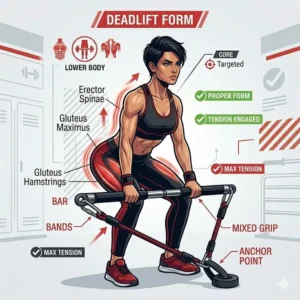
Another pitfall is ignoring the “Ground Force” requirement. If you are doing heavy standing presses or deadlifts, the bands are pulling upwards against your feet. Without a ground plate (like the one provided with the X3 or BodyBoss), the bands will compress the small bones in your feet or slip out from under your arches. Many people try to “DIY” this by standing on the bands, but this leads to uneven tension and potential injury.
Finally, don’t ignore the band quality. A great bar is useless if it comes with cheap, “dipped” latex bands that dry out and snap within three months. Look for layered latex or fabric-covered bands. They are more expensive upfront but offer a much smoother “stretch” and significantly higher safety ratings.
Exercise Resistance Bar vs. Free Weights: The Truth
The debate between elastic and gravitational resistance is often framed as “which is better?” but the real question is “which is better for your current goal?” Free weights provide constant tension based on gravity. A 40 lb dumbbell is 40 lbs at the bottom, middle, and top. This is great for measuring raw strength, but it’s hard on the joints at the “sticking point” of a lift.
An exercise resistance bar provides variable resistance. The load is lightest at the beginning of the movement (where you are weakest) and heaviest at the end (where you are strongest). This allows you to overload the muscle at its strongest point without risking injury at the start.
Furthermore, free weights are limited by the direction of gravity. You can only lift them “up.” With a resistance bar and a simple door anchor, you can apply resistance from any angle—sideways, downwards, or diagonally. This makes the bar a superior tool for sports-specific training, such as mimicking a golf swing or a swimming stroke. While iron will always have a place in the powerlifting world, the resistance bar wins on versatility, safety, and joint longevity.
What to Expect: Real-World Performance
When you first unbox your exercise resistance bar, don’t expect it to feel like the gym. The first thing you’ll notice is the “shiver.” Because the bands are elastic, the bar will want to vibrate or move in three dimensions. This is actually a benefit; it’s forcing your core and stabilizer muscles to fire in a way that a guided gym machine never would.
After two weeks of consistent use, you’ll likely feel a different kind of soreness. Traditional weights often cause “DOMS” (Delayed Onset Muscle Soreness) through microscopic tears during the eccentric phase. Resistance bars, because of the variable load, often produce a “pump” that lasts longer and focuses more on the sarcoplasmic hypertrophy (the fluid within the muscle cells).
By month three, most users report significant improvements in grip strength and posture. Because you have to “fight” the bands to keep the bar steady, your upper back and forearm muscles are under constant isometric contraction. The “real-world” result is a body that feels more “knit together” and functional, rather than just “puffy” from isolated machine work.
Long-Term Cost & Maintenance
The total cost of ownership for an exercise resistance bar is surprisingly low. A high-quality steel bar like the GIBBON or X3 should literally last a lifetime. There are no moving parts to rust or break, and the finish is usually powder-coated to resist sweat.
The only “consumable” in your gym is the bands. Depending on the frequency of use and the environment (heat and UV light are the enemies of latex), you should expect to replace your primary bands every 12 to 18 months. To extend their life, follow these three tips:
-
Keep them clean: Wipe them down with a damp cloth after use to remove skin oils and sweat.
-
Avoid sharp edges: Never anchor your bands to a rough metal pole or a sharp-edged door frame.
-
Use silicone spray: A light coating of food-grade silicone spray every few months keeps the latex supple and prevents “crazing” or small surface cracks.
When you compare the $50-$100 annual band replacement cost to a $60/month gym membership, the resistance bar pays for itself in less than a year.
Features That Actually Matter (And Those That Don’t)
Marketing teams love to add “extra” features to fitness gear, but in the world of the exercise resistance bar, simplicity usually wins.
-
What Matters:
-
Rotating End Caps: Essential for wrist health.
-
Steel Core: Essential for heavy lifting.
-
Knurling: Essential for grip when your hands get sweaty.
-
Quality Carabiners: Your primary safety link.
-
-
What Doesn’t Matter:
-
Digital Tension Counters: These are often inaccurate because band tension changes based on how far you stretch them and the ambient temperature. It’s better to track “reps and band color” than a flickering digital readout.
-
Multi-Piece Bars (if you don’t travel): A solid one-piece bar will always be stronger than a bar that screws together. If you are training at home 100% of the time, don’t sacrifice rigidity for portability you’ll never use.
-
Decorative Wraps: Fancy patterns on the bar or bands don’t help you build muscle. Focus on the gauge of the steel and the grade of the latex.
-
By focusing on the engineering rather than the “flash,” you ensure that your money goes into the parts of the tool that actually drive results.
Safety and Regulations Guide
While there is no “Department of Resistance Bars,” reputable manufacturers adhere to ASTM (American Society for Testing and Materials) standards for fitness equipment. When shopping in 2026, look for products that mention “ISO Certification” or “Load Tested” in their descriptions.
Safety is primarily a user-level responsibility. Always inspect your bands for “nicks” or “white spots” before every session. If a band looks like it’s starting to peel, throw it away immediately. A band snapping at full extension can cause serious eye injuries or bruising.
Furthermore, ensure your anchoring point is solid. If you are using a door anchor, always pull the door closed toward the frame rather than against the latch. This prevents the door from accidentally popping open mid-set. Following these basic protocols ensures that your “home gym” remains a place of health, not a source of injury.
✨ Don’t Miss These Exclusive Deals!
🔍 Ready to upgrade your home workouts? Click on any of the products mentioned above to check current availability and start your transformation. Your future self will thank you for the investment!
Conclusion
The exercise resistance bar is no longer a gimmick; it is a refined, scientifically-backed tool for the modern athlete. Whether you choose the premium engineering of the X3 Bar Elite, the travel-ready versatility of the INNSTAR, or the heavy-duty power of the GIBBON, you are investing in a system that prioritizes both results and joint longevity. By moving away from the “ego-lifting” associated with heavy iron and embracing the constant, variable tension of elastics, you open the door to a more sustainable and flexible way of training. In 2026, the best gym in the world is the one you can take with you, and with the right bar, that gym is always in the palm of your hands.
FAQs
❓ Can you actually build muscle with an exercise resistance bar?
✅ Yes. Muscle hypertrophy is driven by mechanical tension, metabolic stress, and muscle damage. A high-quality bar provides immense mechanical tension, especially at the peak of contraction, which is scientifically proven to trigger muscle growth equivalent to free weights…
❓ Which bar is best for someone over 6 feet tall?
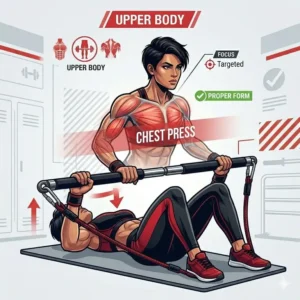
✅ Taller users should opt for a longer bar, such as the INNSTAR (38 inches) or the GIBBON. Shorter bars can make wide-grip movements like chest presses feel cramped and may limit the range of motion during squats…
❓ Do I need a ground plate for my resistance bar?
✅ If you plan on using resistance over 50 lbs while standing, a ground plate is highly recommended. It prevents the bands from painfully compressing your feet and provides a stable, flat surface for consistent force production…
❓ How do I know when to move to a heavier band?
✅ Once you can perform 15-20 repetitions with perfect form and a controlled 2-second “negative” phase, it is time to increase the resistance. You should feel a significant “burn” by the 10th rep…
❓ Is the X3 Bar really worth the $500 price tag?
✅ For those who want a professional-grade system with a high-capacity ground plate and elite-level bands, the investment is justified. However, for casual fitness enthusiasts, mid-range bars offer 80% of the benefits at 20% of the cost…
Recommended for You
- 7 Best natural latex resistance bands for 2026: Get Shredded Fast! 🏋️♂️
- 7 Best Non Latex Resistance Tubes for Safe Strength Training (2026)
- Exercise handles: 7 Best Professional Picks to Boost Your Gains
Disclaimer: This article contains affiliate links. As an Amazon Associate, I earn from qualifying purchases. If you purchase products through these links, we may earn a small commission at no additional cost to you.
✨ Found this helpful? Share it with your friends! 💬🤗
[addtoany]
