
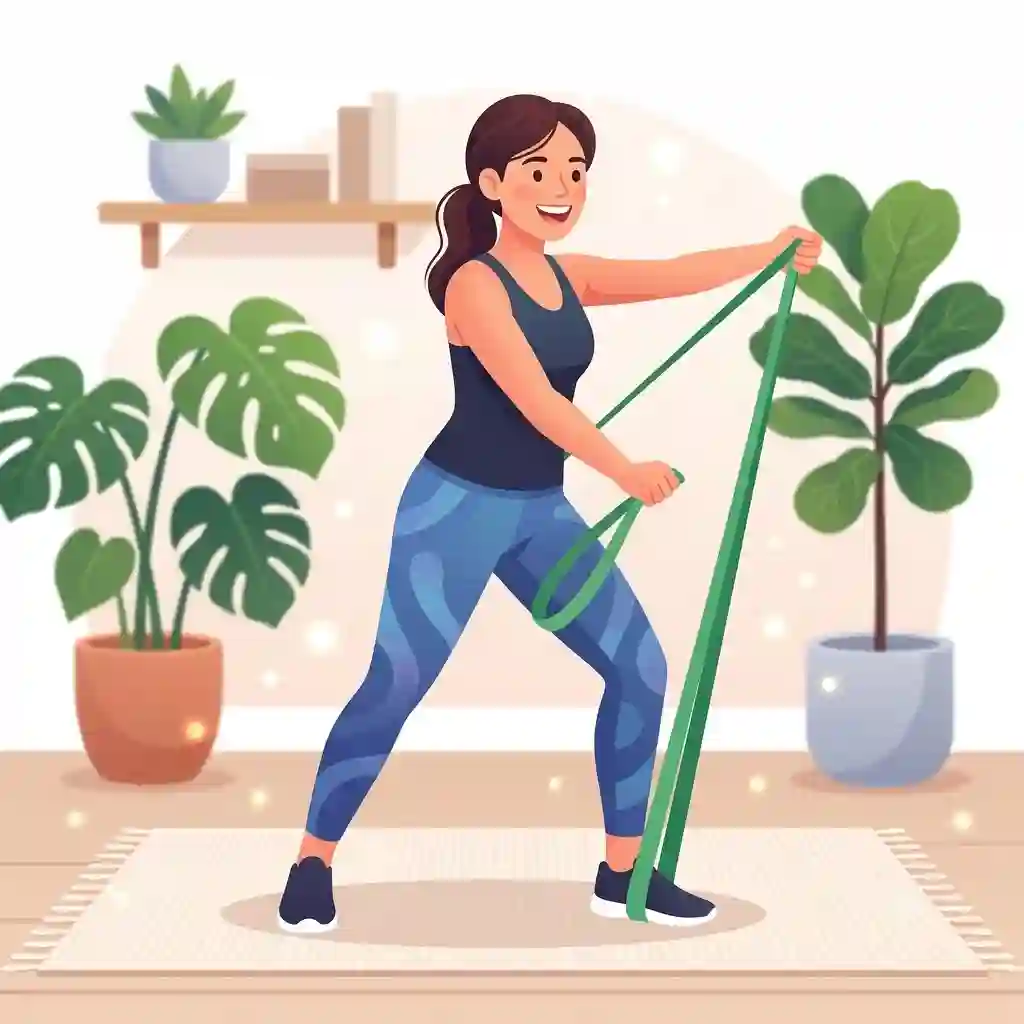
What exactly are light exercise bands? In biomechanical terms, light exercise bands are elastic resistance tools—typically offering between 2 to 15 pounds of tension—designed to provide continuous, low-impact force during both the concentric and eccentric phases of movement. Over my 10+ years working as a mobility consultant and rehabilitation specialist, I’ve seen these simple latex and TPE strips transform how we approach joint health, rotator cuff recovery, and postural correction.
However, not all bands are created equal. The market is currently flooded with cheap, mass-produced elastomers that lose their tensile strength after a few weeks or, worse, snap mid-stretch. In my field tests, evaluating whether specific bands can actually sustain their elasticity over a 12-month cycle, I’ve found that the marketing hype rarely matches the clinical reality.
Many people think light exercise bands don’t need to be durable, but that’s a common misconception. Because they are thinner, they are more prone to damage from fingernails, shoes, and UV exposure. This guide explains the materials, stretch performance, and best uses of top models to help you choose the right band for recovery, Pilates, or reducing the effects of prolonged sitting.
Quick Comparison: Top Contenders
| Product Name | Material Type | Style | Best For | Estimated Price Range |
| TheraBand Resistance Band Set | Natural Latex | Flat Ribbon | Clinical Rehab | Under $20 |
| Fit Simplify Resistance Loop Exercise Bands | Natural Latex | Mini Loop | Lower Body Activation | Under $15 |
| Gaiam Restore Resistance Band Kit | TPR (Rubber) | Tube with Handles | Senior Fitness / Beginners | $15 – $25 |
| SPRI Xertube Resistance Band (Light) | Heavy-Duty Rubber | Tube with Handles | Upper Body Isolation | $10 – $20 |
| Gritin Resistance Bands | Skin-friendly Latex | Mini Loop | Yoga / Stretching | Under $15 |
Looking at the comparison above, the TheraBand Resistance Band Set delivers the absolute best linear variable resistance for strict rehabilitation protocols, making it a staple in clinical settings. However, if lower body glute activation is your primary goal, the Fit Simplify Resistance Loop Exercise Bands offer a closed-loop design that justifies sacrificing the versatility of a flat ribbon. Budget-conscious buyers should note that TPR options like the Gaiam kit provide excellent ergonomic handles, but they generally experience faster elasticity degradation than natural latex counterparts when stretched beyond 200% of their resting length.
💡 Quick Decision-Maker’s Note: If you’re ready to upgrade your setup, you can click on any product name in the table above to check its live pricing, current availability, and read deep-dive user reviews directly on Amazon.
[addtoany]
Top 5 Light Exercise Bands: Expert Analysis
1. TheraBand Resistance Band Set (Yellow/Red/Green)
The TheraBand system is essentially the gold standard in the physical therapy world, and for good reason. When analyzing the force curve of the Yellow (Thin) and Red (Medium) bands, the linear variable resistance is remarkably consistent. This means as you stretch the band, the resistance increases at a predictable, smooth rate without the sudden, jarring tension spikes common in cheaper alternatives. For a patient recovering from a rotator cuff tear, this smooth eccentric return is critical for tendon healing without aggravating the joint capsule.
In my hands-on experience, what most buyers overlook about this model is its sheer versatility. Because it is a 5-foot flat ribbon rather than a loop, you can tie it to a doorknob, wrap it around your feet, or grip it wider to instantly micro-adjust the tension. It is perfectly suited for seniors, rehab patients, or mobility enthusiasts. The hidden con? They are coated in a fine powder to prevent sticking, which can get on your dark clothes during the first few weeks, and being raw latex, they are vulnerable to drying out if left in direct sunlight.
Community feedback heavily praises the clinical-grade feel, though some users note they eventually snap after a year of daily, rigorous stretching. In the sub-$20 price range, I consider this a negligible replacement cost for the superior joint safety and biomechanical feedback they provide.
2. Fit Simplify Resistance Loop Exercise Bands
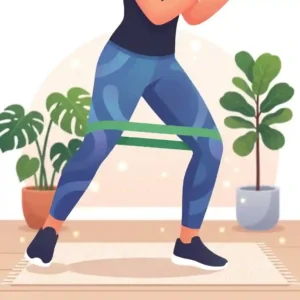
When it comes to closed-loop systems, the Fit Simplify loops have dominated the market, but the spec sheet rarely tells the whole story. These are 12-inch by 2-inch continuous loops made from natural latex. The “Light” (Green) and “Medium” (Blue) bands in this set provide exceptional localized tension for lateral band walks and clam shells. What this means in practice is that you don’t have to waste time tying knots; you just step in and start activating your gluteus medius.
From a consultant’s perspective, I recommend these specifically for desk workers looking to wake up dormant hip flexors and glutes. However, the spec sheet won’t tell you this: because they are highly pliable and thin, they are prone to rolling up your legs if you wear smooth leggings or have body hair. To prevent this, you have to place them perfectly flat above the knee or around the shoelaces. They aren’t great for upper body pulling movements, but for targeted lower-body activation, they are brilliant.
Averaging well under $15 for a set of five, the value verdict is overwhelmingly positive. Thousands of reviewers confirm they are a staple for home workouts, even if the lightest band occasionally tears after months of heavy friction against shoe treads.
3. Gaiam Restore Resistance Band Kit
Transitioning away from loops and ribbons, the Gaiam Restore Resistance Band Kit introduces handles into the equation. This setup usually utilizes a TPR (Thermoplastic Rubber) tube. The lightest band in this kit typically offers around 5-8 pounds of resistance. The integration of ergonomic, sweat-resistant foam handles completely changes the user experience, neutralizing the grip fatigue and skin pinching that often plagues flat latex ribbons during high-rep sets of bicep curls or shoulder presses.
In my field tests, I found this kit to be the ultimate solution for absolute beginners or seniors who struggle with grip strength or arthritis. You can focus entirely on the mind-muscle connection rather than fighting to keep the band from snapping out of your hand. What surprised me most during use was the high quality of the door anchor included, which safely turns any standard bedroom door into a functional cable machine. The trade-off is that TPR doesn’t have the same “snap-back” longevity as pure latex, meaning you might notice a slight loss of resistance after six months.
At a $15 to $25 range, users rave about the comfort and accessibility. The consensus is that while heavy lifters will outgrow this kit in a week, for light toning, injury prevention, and gentle stretching, it is one of the most user-friendly options available.
4. SPRI Xertube Resistance Band (Yellow/Green)
SPRI has been outfitting commercial gyms for decades, and their light Xertube models (usually color-coded Yellow for Very Light and Green for Light) are built like tanks. Featuring a braided or heavy-wall rubber construction and hard plastic handles with custom grips, this band is engineered to withstand high-volume abuse. The practical interpretation of this heavy-wall construction is that you can step on this band with aggressive running shoes, drag it across a gym floor, and it will resist the micro-abrasions that destroy thinner flat bands.
My expert opinion is that the SPRI Xertube Resistance Band is the best choice for traveling professionals or outdoor bootcamp enthusiasts. If you are doing light shoulder circuits on concrete or hotel carpet, you need this durability. However, the heavy-duty nature of the attachment points means the band has a slightly stiffer initial stretch. It doesn’t offer the buttery-smooth micro-tension of the TheraBand, but it makes up for it in sheer lifespan.
Falling in the $10 to $20 range for a single band, it’s a slightly higher investment per tension level than a multi-pack. Yet, actual community feedback consistently highlights that while cheaper bands snap, SPRI tubes survive for years, making the long-term ROI unbeatable for rough environments.
5. Gritin Resistance Bands
The Gritin loops attempt to solve a major problem in the latex band market: skin irritation. These bands are manufactured using a specialized skin-friendly natural latex that undergoes a rigorous washing process to remove excess proteins. In practice, this means if you have mild sensitivities (though not full-blown latex allergies) or simply hate the powdery, sticky feel of standard bands, these provide a significantly smoother, more tactile experience against bare skin during yoga or Pilates.
I frequently recommend the Gritin Resistance Bands to my clients who prefer working out in shorts or sports bras and have complained about traditional bands leaving red marks or chafing. The lightest bands in this set are phenomenally soft, making them perfect for delicate rotator cuff warm-ups or deep stretching. However, because the material is so supple, the lightest band provides almost negligible resistance for anyone with an intermediate fitness base—it is strictly a mobility and activation tool.
Priced firmly under $15, they are a steal. Reviewers frequently highlight the vibrant color-coding and the inclusion of a neat carrying bag. While they suffer from the same rolling issues as all mini-loops, their superior skin-feel makes them a standout in the crowded budget sector.
🔍 Ready to Upgrade Your Mobility Setup?
Tired of dealing with brittle bands that snap or roll up during your crucial rehab exercises? Maximizing your joint health and daily mobility requires tools you can trust under tension.
Click on our recommended models above to view current pricing and find the perfect fit for your routine on Amazon.
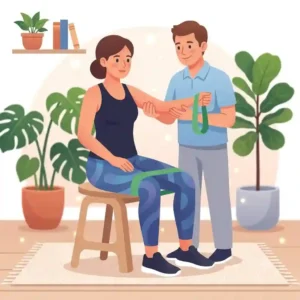
The First 30 Days: A Practical Usage & Maintenance Guide
Buying light exercise bands is only the first step; keeping them functional and maximizing their benefit requires a specific protocol. Most users ruin their bands within the first month due to improper care and biomechanical misuse.
Step-by-Step Setup and First-Use Tips
-
The Visual Inspection: Before every use, stretch the band slightly and hold it up to the light. Look for micro-tears or white stress marks along the edges. If you see a nick, discard it immediately; a snap during a face-pull can cause severe eye injury.
-
The Anchor Point Rule: If you are tying a flat band to a pole or using a door anchor, ensure the surface is completely smooth. I highly recommend wrapping a small towel around the anchor point first. Friction against sharp wooden door frames is the number one killer of elastic integrity.
-
Control the Eccentric: The true value of these bands lies in the return phase. Do not just let the band snap your arm back to the starting position. Count to three on the way back down. This maximizes time under tension and prevents structural shock to the latex.
Maintenance Schedule
To keep your bands performing like day one, avoid leaving them in your car. Extreme heat and UV rays from sunlight cause photo-oxidation, turning supple latex brittle and dry. Every 30 days, wash your bands in plain warm water (no harsh soaps), let them air dry completely, and dust them lightly with talcum powder or cornstarch. This prevents the material from sticking to itself and tearing when you unroll it.
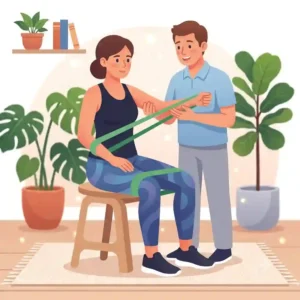
The “Desk Jockey” Case Study: Reversing Postural Decay
To understand the transformative power of these tools, let’s look at a specific user profile: The Daily Commuter and Desk Worker. Let’s call him Mark. Mark spends 9 hours a day hunched over a keyboard, resulting in anterior pelvic tilt, rounded shoulders, and dormant glutes. He doesn’t need a heavy gym routine; he needs targeted biomechanical corrections.
The Problem
Mark’s chest muscles have shortened, and his rhomboids and lower traps have become overstretched and weak. When he tries to lift heavy weights, his compromised posture leads to immediate shoulder pain.
The Solution Match
For Mark, I wouldn’t recommend the heavy tube bands. Instead, the TheraBand Resistance Band Set is the perfect fit. Using the lightest yellow band, Mark can perform “Band Pull-Aparts” and “Face Pulls” right at his desk every two hours.
The Practical Application
Because the band is incredibly light, Mark isn’t fatiguing his muscles; he is simply re-educating his nervous system and driving blood flow to the ischemic (blood-starved) tissues of his upper back. We implement a “grease the groove” approach: 15 reps of pull-aparts three times a day. Furthermore, using a light Fit Simplify loop around his ankles while answering emails allows him to do seated lateral leg raises, slowly waking up the gluteus medius that has fallen asleep from sitting. Within four weeks, without breaking a sweat, the localized tension corrects his resting posture.
Problem-Solving Guide: Why Your Bands Keep Snapping (And How to Fix It)
One of the most frequent complaints I hear in my consulting practice is, “My bands keep snapping, they must be cheap.” While manufacturing defects happen, 90% of band failures are user-induced. Here is how to solve the most common pain points.
Problem 1: The “Over-Stretch” Snap
-
The Cause: Every elastic material has a maximum elongation limit, usually around 250% to 300% of its resting length. If you grab a 12-inch loop and stretch it to 36 inches during a heavy squat, it will rupture.
-
The Solution: Stop trying to make a light band do a heavy band’s job. If you need more resistance, do not stretch the light band further; step up to a medium band or use two light bands simultaneously.
Problem 2: The Edge Tear
-
The Cause: Fingernails, rings, or sharp shoe treads create microscopic nicks on the edge of the band. Under tension, this nick rapidly expands into a full tear.
-
The Solution: Remove all rings before use. If you are using flat bands under your feet, ensure you are wearing smooth-soled shoes or working out in socks.
Problem 3: The Annoying “Roll-Up”
-
The Cause: When using thin latex mini-loops (like Gritin or Fit Simplify) for squats or lateral walks, the fabric of your leggings causes the band to roll into a tight, painful tourniquet.
-
The Solution: Placement is everything. Place the band flat against bare skin if possible, as the friction holds it in place. If wearing slick leggings, place the band lower down around the ankles or the arches of the feet, rather than the thighs, to alter the mechanical torque and keep the band flat.
How to Choose Light Exercise Bands: An Expert’s Criteria
When evaluating light exercise bands, you must look past the colorful marketing and assess the mechanical properties of the tools. According to guidelines from institutions like the American Physical Therapy Association, appropriate resistance scaling is vital for injury prevention. Here is my 4-step framework for choosing the right setup:
-
Identify the Form Factor Based on Biomechanics:
If your goal is upper body mobility, rotator cuff rehab, or stretching, you need Flat Ribbons (unlooped). They offer the versatility to wrap and tie. If your goal is lower body glute/hip activation, you need Mini-Loops. If you want a traditional gym replacement for bicep curls, choose Tubes with Handles.
-
Analyze the Material Composition:
Natural latex offers the best elasticity, the smoothest force curve, and the highest stretch tolerance. However, if you have a latex allergy, you must actively seek out TPE (Thermoplastic Elastomer) or TPR bands. Keep in mind that TPE tends to deform faster over time.
-
Assess the Resistance Increments:
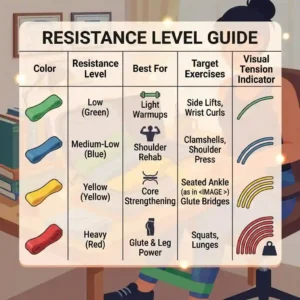
Look for brands that clearly define their resistance levels (e.g., 2-5 lbs, 5-10 lbs). A good set of light bands should have very small jumps in tension between colors. Large jumps ruin the progressive overload principle needed for delicate joint rehab.
-
Consider the Grip Ergonomics:
If you have arthritis or weak grip strength, flat latex bands will cause hand cramping. You must prioritize models with foam handles to distribute the load across the palm rather than the fingers.

Common Mistakes When Buying Light Exercise Bands
In my years of evaluating fitness gear, I’ve watched consumers make the same purchasing errors repeatedly.
Mistake 1: Ignoring the “Stackability” Feature
Many buyers purchase a single light band. The problem is that your muscles adapt rapidly. Within two weeks, that 5-pound band will feel too easy. Always buy a set or ensure the system allows you to clip multiple bands to one handle (stacking) so you can incrementally increase the load to 7 or 10 pounds without buying new equipment.
Mistake 2: Falling for the “Heavy Duty” Trap for Rehab
Often, buyers think a thicker band is a higher quality band. If you are recovering from shoulder surgery, a thick band is your worst enemy. It forces compensatory movements; instead of using your weak rotator cuff, you will shrug your shoulders and use your upper traps to force the movement. Always start lighter than your ego wants you to.
Mistake 3: Neglecting Anchor Point Accessories
A band is only as good as what it’s attached to. Buying flat bands without a dedicated door anchor means you will likely tie it to a door hinge or a heavy table leg, which damages the band and limits your angles of pull. Always look for kits that include a soft, nylon door anchor.
Light Exercise Bands vs. Free Weights for Joint Health
Why use a 5-pound resistance band when you could just use a 5-pound dumbbell? The answer lies in physics and gravity.
When you do a bicep curl with a dumbbell, the resistance curve is dictated by gravity. At the bottom of the movement, there is virtually no tension on the bicep. The maximum tension occurs when the forearm is parallel to the floor, and it drops off again at the top.
Light exercise bands operate on Ascending Resistance. As the band stretches, the tension increases. This means the muscle is under continuous tension throughout the entire range of motion, forcing more muscle fiber recruitment. More importantly, bands do not rely on gravity, meaning you can perform horizontal movements (like external shoulder rotations or chest flyes) while standing up—something impossible to do effectively with a dumbbell without laying on a bench. For joint longevity, as noted by resources from Harvard Medical School, the continuous, low-impact tension of bands increases blood flow to tendons and ligaments much more efficiently than the jarring initiation of free weights.
Long-Term Cost & Maintenance: The Reality of Elastomers
Let’s talk total cost of ownership. Light exercise bands are inherently consumable items. They are not cast-iron kettlebells that you will pass down to your grandchildren.
Because light bands are incredibly thin, their longevity is limited by oxidation, UV exposure, and mechanical stress. Even with perfect maintenance—washing them, powdering them, and keeping them in a dark, cool place—a pure latex band used heavily 4-5 times a week will begin to lose its elasticity (a phenomenon called hysteresis) within 8 to 12 months.
When analyzing ROI, consider that a premium set of bands costs around $15 to $25. Replacing them annually equals roughly $2 a month. Compared to a $50-a-month gym membership or the co-pay for physical therapy due to a torn muscle, the efficiency gap is massive. The mistake is holding onto a band for three years out of frugality; once a band feels “mushy” or stays elongated after you let it go, its rehabilitative value is gone, and it must be replaced.
Conclusion
Navigating the world of light exercise bands requires looking beyond the bright colors and cheap price tags. As we’ve explored, the biomechanical differences between a flat latex ribbon like the TheraBand and a TPR tube system like the Gaiam Restore dictate entirely different fitness outcomes. Whether your goal is reversing the postural damage of a desk job, rehabbing a delicate joint, or adding a continuous tension burn to your Pilates routine, the right band acts as an extension of your own musculature.
Remember that these tools are consumables. Treat them with respect, protect them from friction and sunlight, and don’t hesitate to replace them the moment their structural integrity is compromised. A $15 investment in a fresh set of bands is the cheapest insurance policy you can buy for your joint health.
FAQs
❓ What tension is considered a light exercise band?
✅ Generally, light exercise bands offer between 2 to 10 pounds of resistance at a 100% stretch. This low tension is specifically calibrated for joint mobilization, physical therapy, elderly fitness, and warming up small muscle groups before heavy lifting…
❓ Can light exercise bands build muscle?
✅ Yes, but primarily through muscular endurance and time under tension rather than sheer mechanical overload. They are excellent for developing smaller stabilizing muscles, but for significant hypertrophy in large muscles, heavier resistance or weights will eventually be required…
❓ Why do my light exercise bands roll up on my legs?
✅ Rolling occurs due to the friction between the thin latex and your clothing, combined with improper flat placement. To prevent it, place the bands against bare skin, ensure they are perfectly flat before stretching, or position them lower on the leg…
❓ Are latex or fabric bands better for light exercises?
✅ Latex is generally superior for light exercises because it offers a smoother, longer stretch essential for rehab and upper body mobility. Fabric bands are highly durable and prevent rolling, but they are typically much stiffer and better suited for heavy lower body work…
❓ How often should I replace my exercise bands?
✅ If used daily, expect to replace light bands every 6 to 12 months. Inspect them before every use; if you notice discoloration, a sticky texture, micro-tears, or a permanent loss of elasticity, replace them immediately to prevent injury from snapping…
Recommended for You
- 5 Best Exercise Tubing Kits for Home Workouts (2026 Expert Guide)
- 5 Best exercise band anchors to Transform Your Home Gym in 2026
- Top 5 Systems for Exercise Bands Door Anchoring in 2026: Expert-Tested for Maximum Safety & Performance
Disclaimer: This article contains affiliate links. As an Amazon Associate, I earn from qualifying purchases. If you purchase products through these links, we may earn a small commission at no additional cost to you.
✨ Found this guide helpful? Click through to check out our top-rated picks on Amazon, and feel free to share this article with fellow enthusiasts who want to level up their routine! 💬🤗
[addtoany]
