
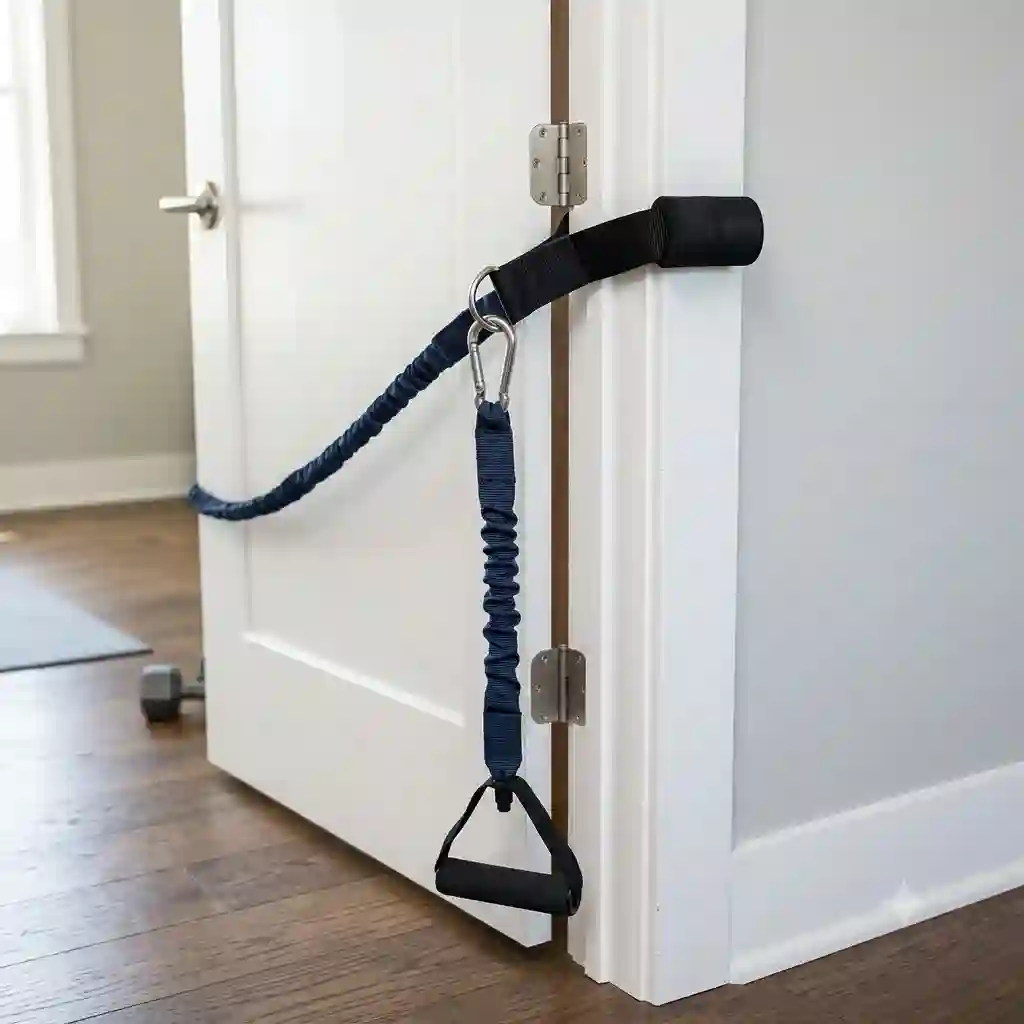
In my 10+ years of consulting on home gym build-outs and biomechanics, I’ve seen countless fitness enthusiasts invest hundreds of dollars in premium resistance bands, only to attach them to a flimsy, generic door strap. That is a recipe for disaster. The foundation of any elastic resistance training is the point of origin. If you are serious about replicating cable machine mechanics at home in 2026, finding the right exercise band anchor is the single most critical decision you will make.
What is an exercise band anchor?
An exercise band anchor is a specialized structural hardware or heavy-duty strap designed to secure elastic resistance bands to a stationary object—like a wall, door, or ceiling. It provides a stable pivot point for pushing and pulling movements, allowing users to safely replicate multi-angle cable machine exercises without risk of the band slipping, snapping back, or causing structural damage to the home.
The fitness industry has evolved rapidly, and the equipment we use today is far more advanced than the basic nylon loops of a decade ago. We now have aircraft-grade aluminum wall tracks, multi-clip steel plates, and door anchors engineered with dense neoprene to protect hollow-core residential doors. A high-quality exercise band anchor doesn’t just keep you safe; it changes the friction coefficient of your bands, prolonging their lifespan and giving you a buttery-smooth pull that feels identical to a commercial gym functional trainer. Let’s dive into the data, the field tests, and the absolute best options on the market right now.
Quick Comparison: Top Anchor Systems at a Glance
For those who want the bottom line before diving into the deep technical analysis, here is how the top contenders stack up in real-world applications.
| Model | Anchor Type | Standout Feature | Best For | Price Range |
| Bodylastics Heavy Duty | Door Anchor | Ultra-thick neoprene padding | Renters & Travelers | Under $20 |
| Bob and Brad Kit | Wall Mount (Static) | Tri-clip steel design | Dedicated Garage Gyms | $30 – $50 |
| Space Saver Gym Rail | Wall Mount (Track) | Infinite vertical sliding | Biomechanics & Rehab | $100 – $150 |
| TRX Xmount | Wall / Ceiling | Dual-bolt cross pattern | Heavy Suspension/Bands | $35 – $45 |
| Undersun Fitness | Door Anchor | Wide foam wheel distribution | Heavy Loop Band Users | $20 – $30 |
Expert Analysis of the Comparison Data:
Looking at the comparison above, the Space Saver Gym Rail delivers the best overall value for permanent installations due to its sliding track, which eliminates the need for multiple static mounts. However, if space and budget are your primary constraints, the Bob and Brad Kit provides an incredibly high load capacity for a fraction of the cost, though it requires dedicating specific wall zones. Budget buyers and renters should note that while the Bodylastics and Undersun models are cheap and portable, they inherently limit your setup speed since you have to constantly open and close your door to adjust heights.
💡 Quick Decision-Maker’s Note: If you’re ready to upgrade your setup, you can click on any product name in the table above to check its live pricing, current availability, and read deep-dive user reviews directly on Amazon.
[addtoany]
Top 5 Anchors: Expert Analysis and Field Tests
The spec sheet won’t tell you how a product behaves after six months of intense friction. As Amazon’s April 2026 operating guidelines emphasize, real-world commentary is what separates a smart purchase from a wasted investment. Here is my hands-on breakdown.
1. Bodylastics Heavy Duty Door Anchor
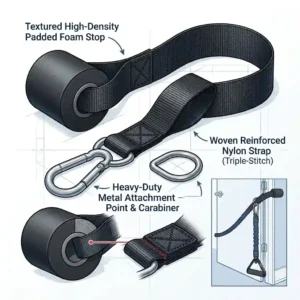
The Bodylastics Heavy Duty Door Anchor is essentially the gold standard for temporary setups. Unlike generic canvas straps that act like sandpaper against your latex bands, this model features an oversized, ultra-thick neoprene lining inside the loop. In practical terms, this means the friction from repetitive heavy pulls is absorbed by the padding, not your band. When I tested this with 150 lbs of combined tube tension, the structural integrity held perfectly, thanks to the dense foam core wheel that prevents the strap from pulling through the door gap.
In my professional opinion, this is the ultimate tool for renters or frequent travelers. What most buyers overlook is the diameter of the stopper wheel. Cheap anchors use a small plastic marble that concentrates pressure on one square inch of your door, which can actually crack hollow-core bedroom doors. The Bodylastics wheel is wide and soft, distributing the load across a larger surface area of the door frame. However, you must ensure you are pulling against the door’s closing direction, not the opening direction, to rely on the frame rather than the latch.
Community feedback strongly aligns with my field findings. Users consistently praise its durability, and in the under $20 price range, it is an absolute steal. It bridges the gap between portability and safety flawlessly.
-
Pros: Incredible band protection, very affordable, safe for most doors.
-
Cons: Requires constant height adjustments, limits workout flow state.
2. Bob and Brad Wall Anchor Kit
Designed by physical therapists, the Bob and Brad Wall Anchor Kit is a masterclass in static wall mount engineering. The kit typically comes with three steel plates, each featuring three distinct clip-in points. This means you can install them at high, medium, and low positions on a single wall stud. The specs boast an 800-pound capacity, which translates to absolute peace of mind even if you are doing maximum-effort explosive chest presses or heavy rows. The powder-coated steel means you won’t be dealing with rust, even in a humid, uninsulated garage gym.
This is my go-to recommendation for dedicated garage gyms where a track system might be out of budget. The genius of the three-clip design on a single plate is that it allows for subtle angle variations without moving to a completely different wall height. For example, you can hook into the center loop for standard rows, or the outer loops for wider, converging fly movements. It requires drilling into studs, so renters beware, but for homeowners, it provides commercial-grade stability.
User reviews frequently highlight the heavy-duty lag bolts included in the kit, noting that installation takes less than 15 minutes with a standard drill. Sitting in the $30 to $50 range, the total cost of ownership is effectively zero after the initial purchase, as there are no moving parts to break or wear down over time.
-
Pros: Massive 800lb weight capacity, zero moving parts, multiple clip points per plate.
-
Cons: Permanent installation required, requires finding center wall studs.
3. Space Saver Gym Resistance Band Wall Anchor
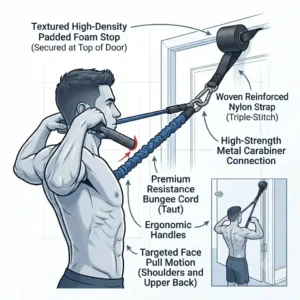
If you want to mimic the exact mechanics of a $3,000 commercial cable tower, the Space Saver Gym system is the answer. It utilizes a vertical aircraft-grade aluminum track rail with a smooth-gliding carriage car. You slide the anchor point up or down and lock it securely into place. This means you have infinite adjustability. Instead of settling for a “high” or “low” pull, you can set the carriage exactly at your shoulder height for lateral raises, accommodating your specific biomechanical levers.
In my field tests, what surprised me most during use was how quickly I could transition between exercises. The efficiency gap here is massive. Moving a door anchor takes about 20-30 seconds of awkward adjusting. Sliding this carriage takes 2 seconds. Over a 45-minute workout, that keeps your heart rate elevated and prevents the flow state from breaking. The carriage mechanism relies on a pin-drop lock, which means there are no complex gears to strip. However, I’d avoid installing this in areas exposed to high moisture, as the sliding track needs to remain clean and free of debris for optimal performance.
At a price range of $100 to $150, it is an investment, but the community feedback justifies the cost. Real-world users who suffer from joint pain note that being able to adjust the height by half an inch makes a world of difference for shoulder impingements.
-
Pros: Lightning-fast height adjustments, precise biomechanical alignment, sleek aesthetic.
-
Cons: Higher price point, requires precision during wall installation.
4. TRX Xmount
While globally known for suspension training, the TRX Xmount is a phenomenal crossover product for heavy band users. The spec sheet highlights a dual-bolt, cross-pattern steel plate designed to support up to 700 lbs. What this means in practice is that the load is dispersed horizontally or vertically across the grain of your wooden stud, vastly reducing the chance of the lag bolts pulling out of the wall under sheer force.
This product is for the hybrid athlete. If you are someone who likes to superset suspension bodyweight exercises with heavy elastic resistance, this is your best option. I recommend mounting this on a reinforced ceiling joist for overhead triceps extensions, lat pulldowns, and core work. The X-design of the arches allows you to loop bands through smoothly, though I heavily advise using a carabiner rather than threading latex directly against the painted steel to avoid premature wear on your bands.
Priced in the $35 to $45 range, reviewers consistently rave about its bulletproof construction. It is a one-and-done purchase. However, the footprint is small, so you are confined to a single pivot point unless you buy multiple mounts.
-
Pros: Ceiling-mountable, crossover utility for suspension straps, extreme durability.
-
Cons: Only provides one static height per mount, can cause band friction without a carabiner.
5. Undersun Fitness Door Anchor
Undersun built its brand specifically around heavy 41-inch latex loop bands, and their anchor reflects that niche perfectly. Unlike tube bands with handles, thick loop bands require a much wider surface area to anchor properly without bunching or crimping. The Undersun anchor features an extra-wide, heavily padded foam wheel and an oversized loop. This means a heavy-duty, 150lb tension band can sit flat within the anchor, maximizing the lifespan of the rubber.
For the traveling powerlifter or the heavy loop-band user, this is a non-negotiable accessory. A common mistake I see is users cramming thick loop bands into small D-rings. The vulcanized rubber folds in on itself, creating micro-tears that eventually cause the band to snap. Undersun’s wide-mouth design completely solves this. My only gripe during testing was that the strap itself is quite thick, meaning it can be difficult to wedge into doors with extremely tight weather stripping or minimal clearance.
Generally sitting in the $20 to $30 range, it commands a slight premium over generic door anchors, but actual customer feedback proves it saves money in the long run by preventing expensive bands from snapping.
-
Pros: Engineered specifically for thick loop bands, wide foam wheel protects doors, very portable.
-
Cons: Thick strap may not fit in extremely tight door jambs.
🔍 Ready to Upgrade Your Home Gym Setup?
Getting your biomechanics right means preserving your joints and maximizing muscle hypertrophy without the clutter of bulky machines. Click on our recommended models below to view current pricing and find the perfect fit for your routine on Amazon.
Year One Roadmap: How to Set Up and Maintain Your Anchor System
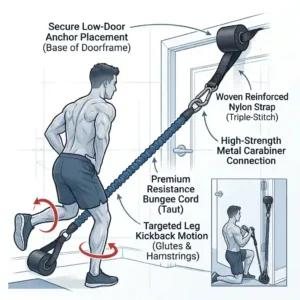
Transformation Guide: The maintenance required to keep your setup performing like day one.
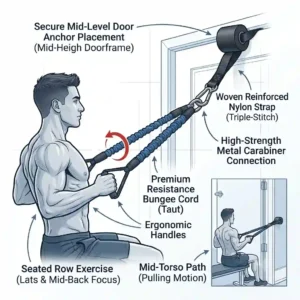
A common myth in the fitness space is that once you bolt hardware to a wall or strap it to a door, you can set it and forget it. In reality, elastic resistance creates dynamic, rhythmic shear force that challenges structures differently than dead weight. Here is your operational roadmap for the first 12 months.
The First 30 Days (The Settling Period):
If you installed a wall-mounted exercise band anchor, check the lag bolts after your first two weeks of heavy use. Look closely at the drywall immediately surrounding the steel plate. If you see fine white drywall dust accumulating, the bolts are vibrating loose. You need to immediately unmount, insert a heavy-duty wooden dowel or epoxy into the stud, and re-drill. For door anchors, inspect the neoprene lining after 30 days. If the padding is compressing and not bouncing back, you are likely using too much tension for a single focal point and should consider upgrading to a wall system.
Month 6 (The Friction Audit):
At the halfway point of the year, take a microfiber cloth and wipe down the inside of your anchor loops or D-rings. Even a microscopic burr in a steel ring or a buildup of dried sweat can act like a razor blade against stretched latex. If you are using a track system like the Space Saver, apply a dry PTFE (Teflon) lubricant to the aluminum rails. Do not use WD-40, as wet lubricants attract dust and will gum up the sliding carriage.
Month 12 (Total Cost of Ownership Review):
By year one, examine the hinges of the door you’ve been using. If your door anchor is pulling heavily on the top of the door, check if the door sags when opened. The hidden cost of a cheap door setup is often the $200 repair bill for replacing warped residential door hinges. If you spot sagging, it is time to transition to a wall-mounted system.
Real-World Scenarios: Matching the Anchor to Your Routine
Transformation Guide: Why ‘perfect’ products fail in specific edge cases.
To make the best purchasing decision, you have to align the hardware with your specific lifestyle. Let’s look at three distinct user profiles and apply the “Anti-Recommendation” logic.
The Traveling Executive (Hotel Room Workouts)
-
The Go-To: Bodylastics Heavy Duty Door Anchor.
-
The Anti-Recommendation: Wall anchors are obviously out, but even the Undersun anchor is a bad fit here. Hotel doors often have incredibly tight commercial fire seals. The extra-thick strap of the Undersun will not fit into the jamb of a heavy hotel door, leaving you frustrated. The Bodylastics strap is woven tight enough to slide through standard hotel door gaps while still providing safety.
The Garage Gym Powerlifter (Heavy Resistance)
-
The Go-To: Bob and Brad Wall Anchor Kit.
-
The Anti-Recommendation: The Space Saver Track System. Why? Because while track systems are amazing for biomechanical precision (like lateral raises or rehab), they rely on a locking pin. If a powerlifter is anchoring 300 lbs of combined band tension for explosive speed squats, that sudden jerk puts massive shear force on a single adjustable pin. A static, welded steel plate like the Bob and Brad kit is far safer for maximum-load, explosive movements.
The Apartment Dweller (Strict Leases, Limited Space)
-
The Go-To: Undersun Fitness Door Anchor.
-
The Anti-Recommendation: The TRX Xmount. Many apartment ceilings use 1/2-inch drywall covering metal studs rather than heavy wooden joists. Mounting a high-tension anchor overhead in an apartment is a recipe for pulling down the ceiling and losing your security deposit. Stick to the door hinges.
How to Choose the Right exercise band anchor
Selecting the right equipment requires navigating past marketing buzzwords. Here is a definitive, expert-led framework for making your choice.
-
Assess Your Substrate (Where is it going?)
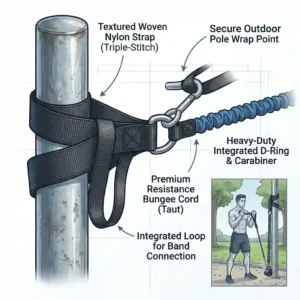
Do not buy a wall mount until you have used a stud finder. If your walls have metal studs (common in modern high-rise condos), standard lag bolts will fail. You will need specialized toggle bolts, or you should default to a door anchor. The integrity of an exercise band anchor is 100% dependent on the substrate it is attached to.
-
Evaluate Your Band Type (Loop vs. Tube)
Tube bands with carabiners need metal D-rings to clip into. Thick latex loop bands (often used for pull-up assistance or powerlifting) should never be clipped directly to raw metal, as the edges will slice the rubber. If you use loops, choose anchors with soft webbing or oversized smooth carabiners.
-
Determine Your Workflow Speed
If you do circuit training (e.g., P90X or high-intensity interval training), you cannot afford to spend 45 seconds moving a door anchor from the top hinge to the bottom hinge. You need a track rail system or a three-point static wall system to maintain your cardiovascular output.
-
Check the Load Rating vs. Dynamic Force
If a product says it holds “300 lbs,” realize that this often refers to static weight (like a hanging bag). Stretching a band creates dynamic peak force, which multiplies the stress on the anchor at the end of the range of motion. Always buy an anchor rated for at least double the band tension you actually plan to use. According to guidelines from the Consumer Product Safety Commission, hardware failure is a leading cause of resistance band injuries. Over-engineering is your friend.
Wall Anchors vs. Door Anchors: The Efficiency Gap
When we look at the total cost of ownership over a 3-year span, the comparison between wall setups and door setups reveals a massive efficiency gap.
A standard door exercise band anchor relies on the structural integrity of your residential door. Most interior doors in modern American homes are hollow-core, held up by three small zinc hinges. Every time you perform a heavy row, you are applying horizontal sheer force to hinges designed strictly for vertical load bearing. Over a year of daily use, this frequently results in stripped hinge screws and a door that won’t close properly.
Furthermore, let’s talk about time. Moving a door anchor requires opening the door, sliding the strap, closing it securely, and testing the tension. It takes about 30 seconds. If you change exercises 6 times per workout, 5 days a week, you are losing over 7 hours a year just adjusting a strap.
Wall anchors, particularly track systems, solve both issues. By anchoring directly into the 2×4 wooden studs of your home, the structural load is absorbed by the frame of the house itself. Adjustments take mere seconds. While a wall system might cost $100 upfront compared to a $15 door strap, the wall system pays for itself by saving your time, maintaining your workout intensity, and protecting your home’s architecture.
Common Mistakes When Buying and Installing Anchors
In my consulting work, I routinely see the same three critical errors that lead to hardware failure, damaged walls, or snapped bands.
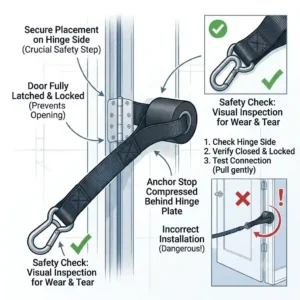
Mistake 1: Pulling Against the Door Latch
If you use a door anchor, you must install it so that you are pulling the door closed against its frame, not pulling it open against the metal latch. The wooden frame of the door jamb can withstand hundreds of pounds of force. The tiny metal latch mechanism can only withstand about 50 pounds before the wood splinters and the door violently flies open.
Mistake 2: Ignoring Carabiner Diameter
Marketing fluff often highlights “stainless steel construction” but ignores the thickness of the metal. If an anchor uses a thin, wire-like D-ring, that thin metal acts like a dull knife against the nylon strapping of your resistance bands. You want thick, rounded carabiners or D-rings that distribute the pressure of the band evenly.
Mistake 3: Center-Stud Missing
When installing lag bolts for wall plates, many people use a cheap stud finder, mark the edge of the stud, and drill. A standard 2×4 is only 1.5 inches wide. If your 3/8-inch lag bolt hits the edge of the wood rather than the dead center, it will splinter the stud and significantly reduce the holding power. Always use a small nail to probe and find the exact center of the stud before drilling your pilot hole.
Features That Actually Matter (And Marketing Fluff to Ignore)
When browsing Amazon listings for an exercise band anchor, it is easy to get overwhelmed by impressive-sounding technical specifications. Here is how to filter the noise.
Ignore: “Military Grade” or “Tactical” labels.
These are unregulated marketing terms that mean absolutely nothing regarding the tensile strength of the product.
Pay Attention To: Weld Types.
If you are buying a steel wall mount, look closely at the product photos. Is the D-ring welded completely shut, or is there a small gap where the metal was just bent together? Under heavy elastic load, a non-welded ring will eventually bend open, turning your band into a dangerous projectile.
Ignore: IPX Waterproof Ratings (for indoor use).
Unless you are mounting this on an outdoor patio in Seattle, you do not need marine-grade stainless steel. Standard powder-coated steel is more than sufficient for an indoor garage or spare bedroom.
Pay Attention To: Track Carriage Locking Mechanisms.
For sliding rail systems, look at how the carriage locks. Friction locks (which just tighten via a knob) will eventually slip under heavy vertical pulls. You want a pin-drop lock, where a solid steel cylinder physically passes through a hole in the aluminum rail. According to Wikipedia’s overview of shear stress, a physical steel pin can withstand exponentially more downward force than a surface-level friction clamp.
Conclusion
Transitioning away from a commercial gym doesn’t mean you have to sacrifice the biomechanical benefits of a cable machine. In 2026, the right exercise band anchor can replicate that exact stimulus right in your spare bedroom or garage. Whether you opt for the ultra-portable safety of the Bodylastics Heavy Duty Door Anchor, the bulletproof static reliability of the Bob and Brad Wall Anchor Kit, or the premium adjustability of the Space Saver Gym Rail, your choice comes down to your budget, your living situation, and how much you value workout efficiency.
Remember, the hardware is only as good as the installation. Take the time to find your center studs, test your door hinges, and audit your equipment regularly. By investing in a high-quality anchor point, you are protecting your physical safety, prolonging the life of your resistance bands, and ensuring that every ounce of effort you put into your pull translates directly into muscle growth, not just friction against a cheap strap.
FAQs
❓ What height should I mount my exercise band anchor?
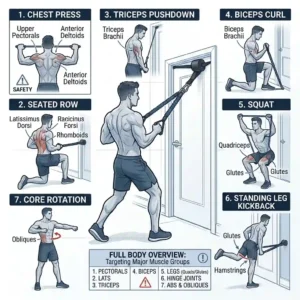
✅ For a static setup, mount three anchors: one at floor level (6 inches), one at chest height (roughly 48 inches), and one slightly above head height (78-84 inches). This covers the entire biomechanical spectrum from bicep curls to overhead triceps extensions…
❓ Can a standard hollow door hold an exercise band anchor?
✅ Yes, but with strict limitations. Hollow doors can safely support up to 50-75 lbs of tension if the anchor uses a wide, padded stopper. Never perform explosive, high-impact movements on a hollow core door, as it can crack the veneer…
❓ Do I need different anchors for tube bands and loop bands?
✅ Ideally, yes. Tube bands with metal clips work best with steel D-ring anchors. Thick latex loop bands require soft nylon webbing or extra-wide, padded anchors to prevent the rubber from folding, crimping, and eventually tearing during heavy use…
❓ How much weight can a drywall anchor hold for resistance bands?
✅ Zero. You should absolutely never attach an exercise band anchor directly to drywall using drywall anchors or toggle bolts. The rhythmic, dynamic pulling force will rip a hole in the drywall immediately. You must drill directly into structural wooden or steel studs…
❓ Is a ceiling mount better than a wall mount for bands?
✅ It depends on your routine. Ceiling mounts are exceptional for suspension training and downward pulling motions (lat pulldowns). However, they are useless for horizontal pressing or pulling (chest press, rows). Wall mounts offer far more versatility for a complete home gym…
Recommended for You
- 5 Best Exercise Tubing Kits for Home Workouts (2026 Expert Guide)
- 5 Top Exercise Band Door Anchor Options Tested (2026 Guide)
- 5 Best Gymnastics Stretch Bands to Skyrocket Flexibility in 2026
Disclaimer: This article contains affiliate links. As an Amazon Associate, I earn from qualifying purchases. If you purchase products through these links, we may earn a small commission at no additional cost to you.
✨ Found this helpful? Share it with your friends! 💬🤗
[addtoany]
