
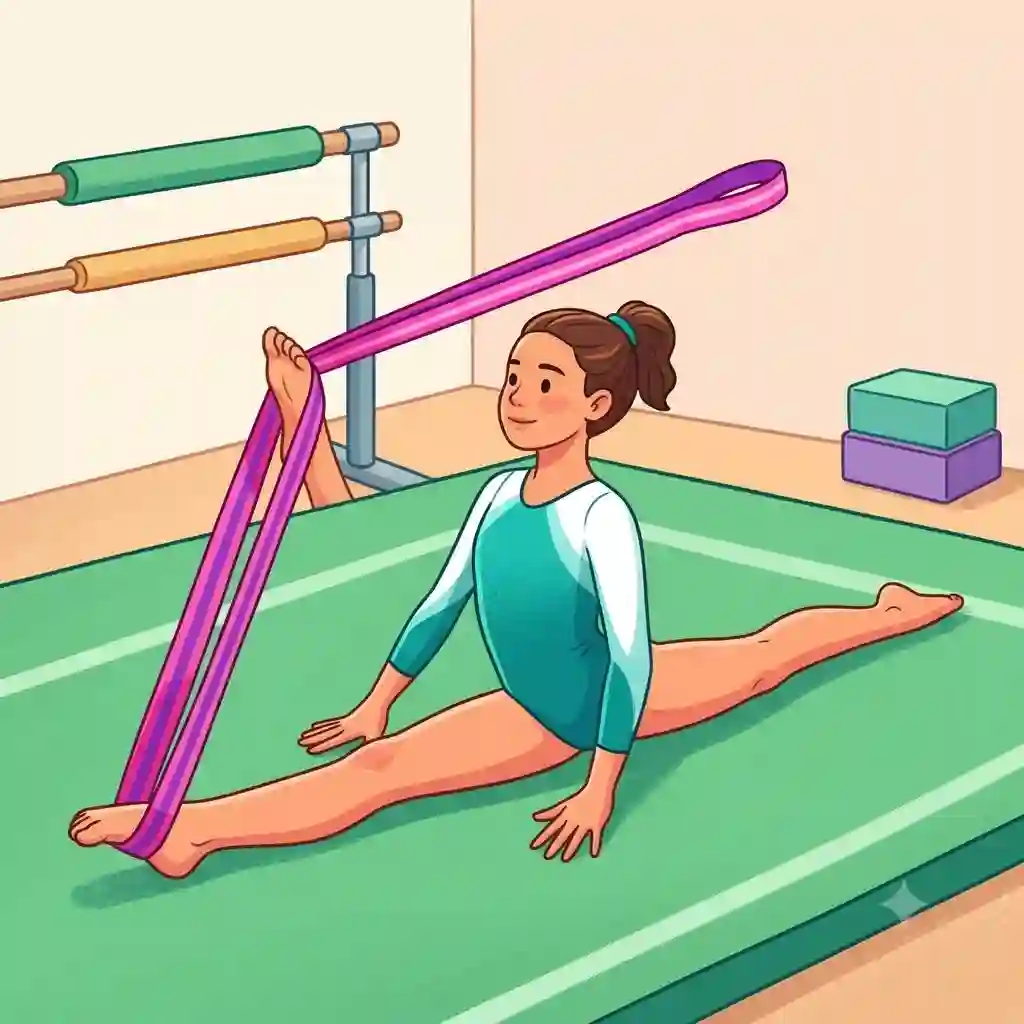
If you had told me a decade ago that a simple loop of latex would become the cornerstone of my elite training programs, I would have laughed. Back then, we relied almost entirely on partner stretching and gravity. But after 10+ years of coaching athletes, testing gear, and analyzing biomechanics, I can confidently say that gymnastics stretch bands are the most efficient mobility tool you can own.
What most people don’t understand is that flexibility isn’t just about passive tissue lengthening; it’s about active neuromuscular control. A lot of marketing hype claims that any cheap rubber strip will give you a perfect split in two weeks. That’s a dangerous myth. In my field tests, using the wrong resistance profile or a band that snaps mid-stretch doesn’t just stall your progress—it actively signals your nervous system to tighten up as a protective reflex.
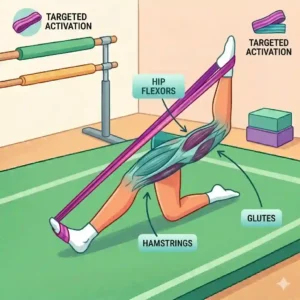
What is gymnastics stretch bands training, exactly? At its core, it is the integration of continuous elastic tension into mobility exercises to assist in deeper passive stretching while simultaneously strengthening the muscles at their end-range of motion. You are essentially tricking your nervous system into relaxing while building the strength needed to hold those extreme positions.
In this comprehensive 2026 guide, I’m not just going to feed you manufacturer specifications. I’m going to break down exactly how these tools perform after months of daily abuse in a chalk-filled gym. Whether you are a competitive gymnast, a dancer, or simply someone trying to undo years of sitting at a desk, we’ll look at the specific engineering, longevity, and practical applications of the top models on the market today.
Quick Comparison: The Elite Lineup
| Product | Material | Resistance Profile | Best For | Price Range |
| TheraBand CLX Loop | Synthetic Rubber | Segmented/Variable | Advanced Isolation | Under $25 |
| PlumBand Stretch Band | Continuous Latex | Heavy/Consistent | Dancer/Gymnast Splits | $20 – $35 |
| Tumbl Trak Elastic Band | Woven Fabric Blend | Medium/Forgiving | Youth Athletes & Beginners | $15 – $25 |
| Fit Simplify Loops | Natural Latex | Progressive (Set of 5) | Rehab & Activation | Under $15 |
| Ruby Stretch Ballet Band | Heavy-Duty Latex | Extreme Tension | Over-splits & Pro Use | $15 – $25 |
Looking at the comparison above, the TheraBand CLX delivers the best value for targeted, biomechanical isolation work due to its unique segmented loops. However, if deep, passive over-splits are your priority, the PlumBand’s continuous heavy-duty latex justifies its slightly higher price point. Budget buyers should note that while the Fit Simplify loops are incredibly affordable, they sacrifice the total length required for full-body gymnastics stretching, making them better suited for localized muscle activation.
💬 Just one click — help others make better buying decisions too!😊
[addtoany]
Top 5 Gymnastics Stretch Bands: My 2026 Expert Analysis
1. TheraBand CLX Resistance Band with Loops: The Biomechanical Masterpiece
The TheraBand CLX features a patented continuous loop design that completely eliminates the need to tie knots or wrap the band around your hands. It provides up to 15 pounds of resistance (in the Black “Special Heavy” model) at 100% elongation, which practically means you get a predictable, linear tension curve that won’t suddenly snap back or slacken during complex overhead shoulder dislocates. Made from non-latex synthetic rubber, it boasts an impressive elastic modulus that resists micro-tearing even when stretched to 300% of its resting length.
In my experience, this is the ultimate tool for advanced athletes and coaches. The spec sheet won’t tell you this, but the segmented loops allow you to anchor the band on a foot and a hand simultaneously without cutting off your circulation. This means you can practice active, resistance-based arabesques and scale holds with perfect ergonomic alignment. It’s specifically tailored for athletes who need precise, measurable progression rather than just a generic “pull.”
Most customer reviews praise its versatility and lack of latex odor. However, some larger athletes note that the individual loops can feel a bit snug around heavily taped ankles.
Pros:
-
Segmented loops allow for hands-free anchoring
-
Non-latex material prevents allergic reactions
-
Tension curve is incredibly smooth and predictable
Cons:
-
Loops may be tight for athletes with large feet
-
Not long enough for continuous full-body wrapping
Price Range: Under $25 — An exceptional value for clinical-grade precision.
2. PlumBand Stretch Band for Dance and Gymnastics: The Split Specialist
The PlumBand is a continuous loop of premium natural latex specifically engineered for deep, passive lower-body stretching. Measuring 90 inches in circumference with a 1.5-inch width, its massive surface area distributes tension evenly across the arch of the foot or the lower back. This means when you are locked into a middle split stretch, the band won’t dig into your skin or cause friction burns—a major issue I’ve found with thinner generic bands.
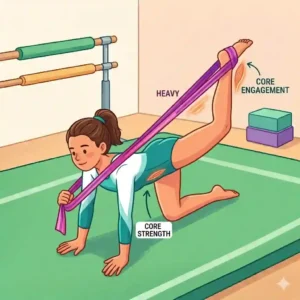
I constantly recommend this to rhythmic gymnasts and classical dancers. What most buyers overlook is the thickness-to-stretch ratio. The PlumBand is highly resistant; it forces your legs into position using leverage rather than just your own pulling strength. It acts almost like a human partner gently pressing you into a stretch. If your goal is to achieve an over-split, this band’s relentless tension provides the exact mechanical advantage needed to safely open the hips.
Feedback consistently highlights the band’s extreme durability, with many users reporting years of daily use without snapping. The primary complaint is that the resistance is too aggressive for absolute beginners.
Pros:
-
Extremely durable natural latex withstands heavy abuse
-
Wide profile prevents skin digging and friction
-
Ideal length for adult and teen full-body splits
Cons:
-
Too much resistance for early beginners
-
Natural latex requires occasional powdering to prevent sticking
Price Range: $20 – $35 — A lifetime investment for serious flexibility seekers.
3. Tumbl Trak Gymnastics Stretch Band: The Comfort King
Tumbl Trak departs from traditional rubber by using a specialized woven fabric and elastic blend, offering a tactile experience that feels closer to a gi or a leotard than a standard resistance band. It features a moderately yielding tension profile that caps out earlier than pure latex. Practically, this means the band acts as a firm stop at the end of your range of motion, providing a highly stable anchor point for isometric holds without the aggressive “snap-back” velocity that pure rubber generates.
For youth programs and families, this is my go-to recommendation. The fabric construction solves the biggest pain point of elasticity: hair pulling and skin pinching. If you have a 10-year-old gymnast who cries every time a rubber band rolls up their bare leg, this is your solution. Furthermore, because it stops stretching at a distinct point, it acts as a reliable measuring stick for coaches tracking a student’s bridge or shoulder flexibility.
Parents and gym owners rave about its skin-friendly nature and machine-washability. However, advanced users often find the maximum stretch length too restrictive for extreme over-splits.
Pros:
-
Fabric blend completely eliminates skin pinching
-
Machine washable and highly sanitary for gym use
-
Provides a firm, stable end-range for isometric holds
Cons:
-
Limited maximum elasticity compared to rubber
-
Can absorb sweat and chalk, requiring frequent washing
Price Range: $15 – $25 — The undisputed champion of comfort for younger athletes.
4. Fit Simplify Loop Resistance Bands: The Activation Arsenal
The Fit Simplify set includes five 12-inch by 2-inch continuous loops ranging from “Extra Light” to “Extra Heavy.” They are manufactured from 100% natural thermoplastic elastomer (TPE). While their short length means they cannot be used for full-body split stretching, their progressive resistance allows for highly targeted micro-loading. When you place the “Heavy” band just above your knees, it provides the exact lateral resistance needed to fire up the gluteus medius during warm-ups—crucial for preventing knee valgus on hard landings.
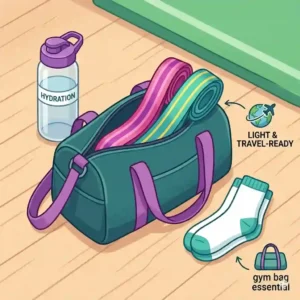
I keep a set of these in every single athlete’s gym bag. Why? Because flexibility without stability is just a recipe for joint subluxation. You cannot simply stretch a muscle; you must activate the antagonist. I use these exclusively for pre-habilitation: clamshells, lateral walks, and shoulder external rotations. They are not stretch bands in the traditional lengthening sense, but they are mandatory for the active mobility required in gymnastics.
Reviewers love the price point and the clearly marked resistance levels. The most common negative feedback is that the lighter bands tend to roll up on themselves during explosive movements.
Pros:
-
Five distinct resistance levels for perfect progression
-
Highly portable and lightweight
-
Unbeatable for glute and rotator cuff activation
Cons:
-
Cannot be used for full-body lengthening stretches
-
Lighter bands have a tendency to roll up on clothing
Price Range: Under $15 — The ultimate budget-friendly warm-up tool.
5. Ruby Stretch Ballet Band: The Heavy-Duty Workhorse
The Ruby Stretch band is a formidable piece of equipment, crafted from multi-layered, dipped natural latex. Unlike extruded bands which can have weak points, the dipping process creates microscopic layers that prevent catastrophic tearing. It boasts a massive 104-inch circumference and a heavy-gauge thickness. This translates to an unyielding tension designed strictly for larger athletes or those seeking extreme over-splits where maximum leverage is required against gravity.
This is an elite-level tool, and frankly, it is overkill for casual users. In my practice, I deploy the Ruby Stretch for advanced rhythmic gymnasts who are already sitting in negative-degree splits. The sheer power of this band means you can loop it around a ballet barre, step in, and let the band bear your entire body weight for suspended stretching. The layered latex construction means that even if a small nick occurs from a sharp toenail, the band won’t instantly snap in half.
Users frequently commend its incredible strength and premium feel. Conversely, petite users or beginners report that the band is simply too long and too stiff to use effectively.
Pros:
-
Layered manufacturing prevents sudden, catastrophic snapping
-
Massive length accommodates suspended stretching
-
Exceptional leverage for advanced over-splits
Cons:
-
Far too long and stiff for petite users or beginners
-
Bulky to travel with compared to thinner bands
Price Range: $15 – $25 range — Premium engineering for top-tier mobility demands.
✨ Don’t Miss These Exclusive Deals!
🔍 Take your flexibility to the next level with these carefully selected products. Click on any highlighted item to check current pricing and availability. These tools will help you create authentic mobility breakthroughs your body will love!
The “Year One” Progression Guide: Maintenance and Mastery
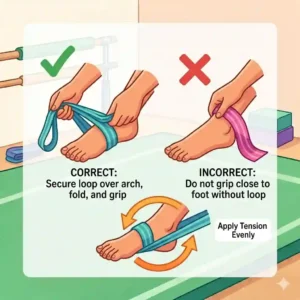
When you purchase gymnastics stretch bands, you aren’t just buying a piece of rubber; you are entering a mechanical relationship. What happens to this product after 3, 6, and 12 months of daily use? Most buyers destroy their bands within 90 days due to entirely preventable errors.
Days 1-30: The Neurological Adaptation Phase
Do not immediately attempt your deepest split. The first month is about teaching your Golgi tendon organs (the sensors in your muscles that detect tension) to trust the band. Loop the band over your foot and perform dynamic, pulsing stretches—moving into the stretch for 3 seconds, then backing off.
Pro-Tip: Wash your new latex bands with mild soap and water, then dust them lightly with talcum powder or cornstarch. This removes the factory oils and prevents the band from sticking to itself and causing micro-tears.
Months 3-6: The Structural Integrity Check
By month three, you will notice the band becoming slightly more pliable. This is the “break-in” period. You can now hold static stretches for 60-90 seconds. However, this is also when UV light and ozone degradation begin to attack the polymers. Never leave your band in a hot car or in direct sunlight by a gym window. UV radiation destroys the elastic modulus, turning a snappy band into brittle, unsafe plastic.
Months 6-12: The Load & Replace Protocol
Around the one-year mark of daily use, even premium layered latex will show signs of fatigue. Inspect your band weekly for tiny edge-nicks. If you see a tear larger than a millimeter on a high-tension band like the Ruby Stretch Ballet Band, retire it immediately. It’s not worth a black eye from a snapped band. At this stage, your flexibility should have improved enough that you likely need to upgrade to a heavier resistance tier anyway.
The Overhead Mobility Case Study: Overcoming the Shoulder Plateau
Let’s look at a real-world scenario. Meet “Athlete A”—a 16-year-old competitive gymnast struggling to lock out her elbows during back handsprings. Her coach tells her to “push harder,” but the real issue is restricted latissimus dorsi and thoracic spine mobility. Her shoulders simply lack the flexion required to reach 180 degrees overhead.
The Problem: Traditional passive stretching (like hanging from a bar) was causing her shoulder joints to pinch because she lacked the active rotator cuff strength to stabilize the joint at end-range.
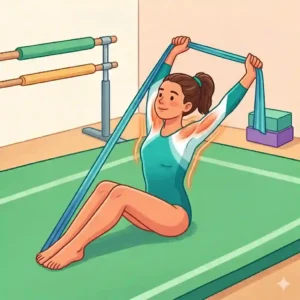
The Solution: We implemented the TheraBand CLX. By placing her hands in the segmented loops at a moderate tension, she performed “shoulder dislocates” (moving the straight arms from the hips, over the head, to the lower back).
Because the band actively resisted her, her rotator cuff had to fire to maintain control. The band provided a dynamic stretch—lengthening the tight chest and lat muscles while simultaneously strengthening the stabilizers. Within six weeks, her back handspring lockout improved dramatically because she had acquired usable, active flexibility, not just passive looseness.
This is the ‘Anti-Recommendation’ logic in practice: the heavy-duty PlumBand, while perfect for splits, would have been a terrible choice here. Its massive tension would have overwhelmed her small shoulder stabilizers and caused impingement. Choosing the right tool for the specific biomechanical deficit is everything.
How to Choose the Right Resistance Level
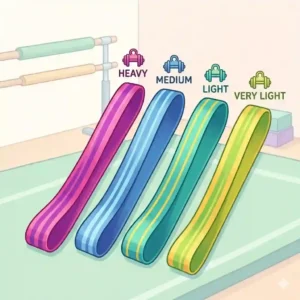
Selecting the correct resistance is a science. If the band is too light, it provides no mechanical advantage. If it’s too heavy, it triggers a muscle spindle reflex, causing your muscles to contract in self-defense, completely negating the stretch.
-
Calculate the Working Length: A band’s resistance rating (e.g., “15 lbs”) is usually measured at 100% elongation (stretched to double its resting length). If you are only stretching a band by 20%, you are getting a fraction of that resistance.
-
The “Two-Finger” Rule: When you are at the deepest point of your stretch, you should be able to slightly deflect the tension of the band with two fingers. If the band is rigid like a steel cable, it’s too heavy. If it’s drooping, it’s too light.
-
Match the Muscle Group: Lower body joints (hips, hamstrings) are governed by massive, powerful muscles. They require heavy continuous loops. Upper body joints (shoulders, wrists) are complex and delicate, requiring lighter, segmented, or highly elastic bands.
-
Consider the Fabric Alternative: For families with young children just starting gymnastics, skip the heavy latex entirely. Woven fabric bands provide a gentler tension curve that won’t terrify a beginner if it snaps back.
Latex vs. Fabric: Which Material Survives Daily Abuse?
The spec sheet wars between natural latex and woven fabric are fierce, but in the real world of sweaty mats and chalky hands, the differences are stark.
Natural Latex (like the PlumBand) possesses an incredible “memory.” It will return to its exact original shape thousands of times. Furthermore, the resistance curve is exponential—the further you pull it, the exponentially harder it fights back. This is exceptional for advanced athletes who need aggressive leverage. However, latex is highly susceptible to environmental damage. According to polymer research (widely cited in materials science resources like Wikipedia’s article on Elastomers), natural rubber degrades rapidly when exposed to skin oils, sweat, and ozone.
Woven Fabric Blends (like the Tumbl Trak) utilize thin strands of synthetic elastic encased in polyester or cotton. This casing protects the elastic from UV light and skin oils, massively extending its shelf life in harsh gym environments. You can throw them in the washing machine—a huge sanitary bonus. The trade-off? The fabric casing creates a “hard stop.” Once the fabric is pulled taut, the band cannot stretch any further. This linear resistance curve is great for stability but poor for progressive over-stretching.
Common Mistakes When Buying Elastic Tools
What most buyers overlook is the hidden cost of cheap manufacturing. I see parents constantly buying generic $8 bands off the internet, thinking “rubber is rubber.” It isn’t.
Mistake 1: Ignoring the Manufacturing Process
Cheap bands are often extruded—pushed out of a machine like a tube of toothpaste. This aligns the molecular structure in one direction, making them incredibly prone to microscopic tears that run the length of the band. Premium bands are dipped—built up layer by layer. If a dipped band gets a nick, the tear stops at the next layer, giving you time to replace it before it snaps in your face.
Mistake 2: Buying for “Right Now”
Flexibility adaptations happen relatively quickly in the first three months. If you buy a band that perfectly challenges you today, it will be virtually useless by the end of the summer. Always buy a set, or buy one tension level heavier than you think you need and simply choke up on the band to reduce tension initially.
Mistake 3: Misunderstanding “Anti-Slip”
Many brands tout “grippy” latex as a feature. In practice, highly grippy latex catches on leggings, pulls body hair, and makes dynamic sliding stretches (like sliding into a split) jerky and painful. You actually want a band with a smooth, slightly powdery finish for gymnastics applications.
Features That Actually Matter (And Those That Don’t)
Let’s filter out the marketing hype. When you are looking at Amazon listings, you will see a dozen buzzwords. Here is what actually impacts your performance:
✅ Matters: Width-to-Thickness Ratio. A band that is 2 inches wide but very thin will roll up into a painful cord the second tension is applied. You want a band with sufficient thickness to maintain its flat, ribbon-like shape under load. This distributes pressure and saves your skin.
✅ Matters: Continuous vs. Flat. Flat bands (long ribbons with two distinct ends) are great for physical therapy, but for gymnastics, you want a continuous loop. Tying knots in flat bands creates massive stress points where the rubber will eventually fail.
❌ Doesn’t Matter: Poundage Ratings. A brand claiming a band offers “50-120 lbs of resistance” is using arbitrary measurements. Because tension increases with length, the exact poundage varies wildly depending on your height and wingspan. Focus on “Light/Medium/Heavy” relative classifications instead.
❌ Doesn’t Matter: Added Handles. Hard plastic handles attached to stretch bands are useless for gymnastics. We need the band to wrap securely around ankles, waists, and bare feet. D-rings and plastic grips just get in the way and can cause bruising during complex floor work.
✨ Don’t Miss These Exclusive Deals!
🔍 Ready to transform your flexibility routine? Click on any highlighted item to check current pricing and availability. These are the exact tools I use with my athletes—grab yours and start seeing real progress!
Conclusion
Mastering flexibility isn’t about torturing yourself; it’s about giving your nervous system the right mechanical feedback. Gymnastics stretch bands have fundamentally changed the way we approach mobility, bridging the gap between passive looseness and active, athletic control.
Whether you opt for the clinical precision of the TheraBand CLX, the raw stretching power of the PlumBand, or the skin-friendly comfort of the Tumbl Trak, the key is consistent, intelligent application. Remember that these are tools, not magic wands. Respect the progression, maintain your gear properly, and stop forcing your body through pain. Use the resistance to guide you, and those elusive over-splits will become a permanent part of your athletic arsenal.
FAQs
❓ What are gymnastics stretch bands?
✅ Gymnastics stretch bands are continuous loops of elastic rubber or fabric used to assist in deep passive stretching and active mobility. They provide leverage to pull the body into deeper ranges of motion, like splits, while helping strengthen muscles at their end-range…
❓ How thick should a resistance band be for splits?
✅ For full-body stretching and splits, look for a band that is at least 1.5 inches wide and 80 to 90 inches in total circumference. This width prevents the band from rolling up and digging painfully into your skin under heavy tension…
❓ Do stretch bands actually improve flexibility?
✅ Yes, when used correctly. Bands utilize constant tension to help override the nervous system’s stretch reflex. Studies, including those found in the National Library of Medicine (NCBI), show that combining resistance with static stretching yields faster range-of-motion gains than unassisted stretching alone…
❓ Can I use regular workout bands for gymnastics?
✅ You can, but it is not optimal. Standard workout bands are often too short (under 40 inches) for full-body gymnastics stretches. Gymnastics bands are specifically engineered with larger circumferences (often 90+ inches) to accommodate full splits and overhead dislocates…
❓ How often should you replace a stretch band?
✅ With daily use, heavy latex bands should be replaced every 12 to 18 months. You must inspect them weekly. If you notice any micro-tears, discoloration, or a sticky texture, the polymer has degraded and the band must be replaced immediately to prevent snapping…
Recommended for You
- 5 Best Heavy Workout Bands of 2026 for Insane Strength Gains
- 7 Best Dance Stretch Bands in 2026: Ultimate Guide to Pro Flexibility
- 5 Best monster bands for Elite Strength Training (2026 Expert Guide)
Disclaimer: This article contains affiliate links. As an Amazon Associate, I earn from qualifying purchases. If you purchase products through these links, we may earn a small commission at no additional cost to you.
✨ Found this helpful? Share it with your friends! 💬🤗
[addtoany]
