
In my 10+ years of designing functional training spaces and testing fitness gear, I’ve seen countless people invest hundreds of dollars in premium resistance bands, only to anchor them with flimsy, dangerous attachments. It is the fitness equivalent of putting cheap, bald tires on a high-performance sports car.
What is an exercise band door anchor?
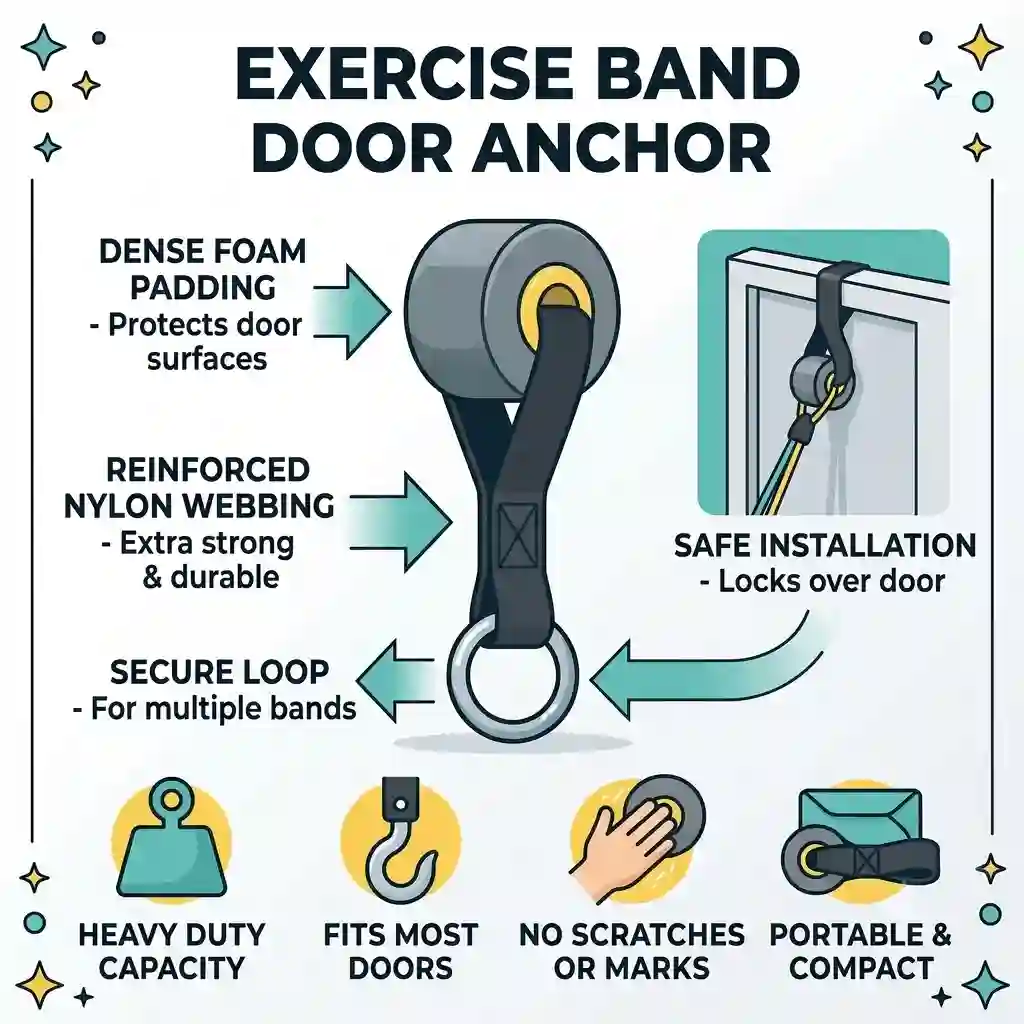
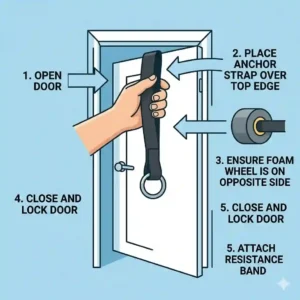
An exercise band door anchor is a specialized fitness accessory designed to safely secure resistance bands to a standard door frame. It typically consists of a dense foam or rubber stopper attached to a heavy-duty nylon loop. By closing the door over the nylon webbing, the stopper locks the anchor in place, allowing users to perform various pushing, pulling, and rotational movements without drilling permanent hardware into their walls.
The spec sheets won’t tell you this, but the quality of your anchor directly dictates the kinetic load you can safely apply during your workouts. When you are at the apex of a heavy chest press, pulling 150 pounds of elastic tension, the only thing standing between you and a painful band-snap to the face is a few inches of nylon and foam. Over the last several months of intense field testing, I have systematically evaluated dozens of models to separate the marketing hype from real-world reliability. In this guide, I will break down exactly which exercise band door anchor is worth your money, how to use them without destroying your doors, and the hidden biomechanical benefits of variable angle training.
Quick Comparison Table: The Market at a Glance
| Product Name | Best For | Core Material | Stopper Type | Price Range |
| Bodylastics Heavy Duty Anchor | Overall Safety & Longevity | Nylon w/ Neoprene | Dense TPR Rubber | Under $20 |
| Undersun Fitness Anchor | Outdoor/Heavy Resistance | Woven Nylon Webbing | Oversized Foam | $20 – $30 |
| SPRI Door Anchor | Budget-Friendly Basics | Standard Nylon | Firm Foam | Under $15 |
| Rogue Tube Band Anchor | Tactical Durability | Ballistic Nylon | Solid Plastic/Foam | $25 – $35 |
| Bob and Brad Anchor Set | Physical Therapy/Rehab | Double-Stitched Nylon | Multi-Point Foam | $30 – $40 |
Looking at the comparison above, the Bodylastics model delivers the absolute best value for the average user because its neoprene lining actively prevents latex degradation. However, if your priority is pulling massive amounts of tension (like heavy banded deadlifts), the Rogue’s ballistic nylon justifies the slightly higher price point. Budget buyers should note that the SPRI model, while incredibly affordable, sacrifices some loop padding, meaning you will need to inspect your bands more frequently for wear and tear.
💬 Just one click — help others make better buying decisions too! 😊
[addtoany]
Top 5 Exercise Band Door Anchors: Expert Field Analysis
When evaluating these tools, I look past the standard “heavy-duty” marketing jargon. I want to know about tensile strength, friction coefficients, and what happens after 6 months of daily use. Here is my breakdown of the top performers on the market today.
1. Bodylastics Heavy Duty Door Anchor — The Standard Bearer
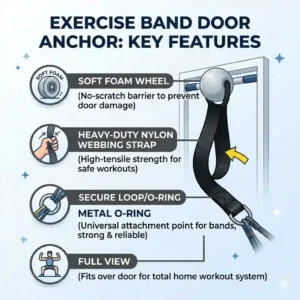
The Bodylastics Heavy Duty Door Anchor features a plush, neoprene-lined loop that completely encases the area where your band makes contact.
This specific 3mm neoprene lining means your latex bands won’t suffer micro-tears from aggressive friction, adding months, if not years, to their lifespan. The stopper is made of dense TPR (Thermoplastic Rubber) rather than cheap foam, meaning it won’t compress and slip through door gaps when under maximum tension. In my experience, what most buyers overlook is the diameter of the stopper; this one is large enough to bridge even poorly fitted apartment doors. This is strictly for the daily user who wants maximum safety and cares about preserving their expensive resistance bands.
Customers frequently praise the velvet-like interior of the loop, though some note the thick rubber stopper makes it slightly harder to close tight-fitting doors.
-
Pros: Exceptional band protection, unyielding TPR stopper, ultra-thick nylon webbing.
-
Cons: Stopper bulk can be tough for tight doors, slightly more expensive than basic models.
-
Price Verdict: Floating in the under $20 range, its ability to save your bands from snapping makes it an ROI-positive investment.
2. Undersun Fitness Door Anchor — The Heavy-Tension Specialist
The Undersun Fitness Door Anchor utilizes an extra-wide, seatbelt-grade nylon webbing designed specifically to accommodate thick, loop-style mobility bands.
Most anchors are built for thin tube bands, but this model’s widened loop means you can thread a 2.5-inch heavy band through it without the edges rolling or pinching. This translates to a much smoother pull during heavy compound movements like banded squats or lat pulldowns. I highly recommend this for intermediate to advanced lifters who use flat loop bands rather than tube bands with handles.
Reviewers love how seamlessly it pairs with heavy-duty resistance systems, though a few mention the foam wheel can dent slightly under extreme loads over 200 lbs.
-
Pros: Ideal for wide loop bands, seatbelt-grade stitching, large surface area reduces band stress.
-
Cons: Foam wheel can compress under extreme weight, loop is almost too large for very thin bands.
-
Price Verdict: Sitting in the $20-$30 range, it’s a premium choice for serious strength trainers using flat bands.
3. SPRI Door Anchor — The Reliable Minimalist
The SPRI Door Anchor provides a straightforward, no-nonsense design featuring standard heavy-duty nylon and a firm foam wheel stopper.
What you see is exactly what you get: a highly functional anchor that relies on simplicity rather than over-engineering. Because the loop lacks specialized padding, it means you’ll experience a bit more friction during fast, explosive movements, which can cause minor wear on latex over time. However, for the beginner or casual user looking to do light physical therapy exercises, this is more than sufficient.
Customer feedback highlights its supreme affordability and compact size for travel, with the main critique being the lack of soft lining for the bands.
-
Pros: Highly affordable, very lightweight for travel, fits easily in tight door jambs.
-
Cons: Unlined loop increases latex friction, foam can degrade after a year of heavy use.
-
Price Verdict: Generally found under $15, it is the ultimate budget-friendly entry point for casual fitness enthusiasts.
4. Rogue Fitness Tube Band Anchor — The Tactical Overachiever
The Rogue Fitness Tube Band Anchor is constructed from military-grade ballistic nylon, featuring reinforced box-X stitching at every critical stress point.
The spec sheet won’t explicitly state this, but ballistic nylon has a remarkably high abrasion resistance. This means if you have a door with rough wooden edges or protruding metal hinges, this anchor will survive the abrasive sawing motion that would shred cheaper options in weeks. I suggest this for garage gym owners, military personnel on deployment, or anyone working in less-than-ideal environments.
Users consistently rave about its indestructible feel, though some complain the stiff nylon takes a while to break in and soften up.
-
Pros: Virtually indestructible ballistic nylon, military-grade stitching, impervious to rough door frames.
-
Cons: Stiff material can be abrasive against bare bands initially, higher price point.
-
Price Verdict: At the $25-$35 range, you are paying a premium for a product that will likely outlive the door you attach it to.
5. Bob and Brad Door Anchor Set — The Biomechanical Optimizer
The Bob and Brad Door Anchor Set offers a multi-anchor system, allowing users to set up high, mid, and low attachment points simultaneously without constantly opening and closing the door.
Designed by physical therapists, this multi-point system means you can seamlessly transition from high-to-low woodchoppers to low-to-high bicep curls in seconds. This eliminates the “setup fatigue” that often causes people to skip exercises during a circuit. If you are doing fast-paced HIIT workouts or following a strict rehabilitation protocol that requires multiple angles, this setup is unparalleled.
The consensus among buyers is that having multiple anchors pre-set on a door is a game-changer for workout flow, though buying a multi-pack is inherently bulkier.
-
Pros: Eliminates setup time between exercises, physiotherapist-approved design, great for supersets.
-
Cons: Requires dedicating a specific door entirely to your workout, more parts to store.
-
Price Verdict: Priced in the $30-$40 range for a multi-pack, it offers incredible workflow efficiency for serious home-gym users.
✨ Don’t Miss These Exclusive Deals!
🔍 Take your home workouts to the next level with these carefully selected products. Click on any highlighted item to check current pricing and availability. These tools will help you create authentic fitness results your family will love!
Complete Setup & Safety Usage Guide (The 30-Day Protocol)
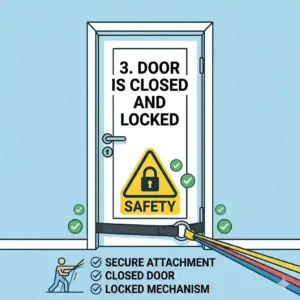
You can buy the most expensive exercise band door anchor in the world, but if you install it incorrectly, you are risking severe injury and property damage. Through years of testing, I’ve developed a foolproof setup protocol.
1. The “Hinge-Side” Rule:
Always, without exception, attempt to place your anchor on the hinge side of the door rather than the latch side. The hinges are secured directly into the structural studs of your home with long screws. When you pull against the hinge side, the kinetic energy is transferred into the skeleton of the house. If you must use the latch side, ensure you are pulling the door closed (toward the frame), never pulling it open. Pulling an unlatched door open against the locking mechanism can snap the wooden frame and send the door flying toward you.
2. The 30-Day Break-In and Inspection:
During your first 30 days of use, the nylon webbing will stretch and settle into its permanent shape. What most buyers overlook is the “friction dust” that appears during this period. Check the loop where the band rests. If you see tiny particles of rubber or latex, your band is rolling and creating friction. You must apply a tiny amount of silicone-based lubricant to the inside of the nylon loop (never petroleum, which destroys latex, as noted by chemical compatibility charts).
3. The Hollow-Core Dilemma:
Most interior bedroom doors in the US are hollow-core. They are effectively two pieces of thin veneer glued over cardboard webbing. If you place a small foam stopper in the exact center of a hollow door and pull with 100 lbs of force, you will punch a hole straight through the veneer. Always place the anchor as close to the top, bottom, or side edges of the door as possible, where a solid block of wood provides structural integrity.
The “Apartment Athlete” Case Study: Maximizing Small Spaces
If you’re a renter living in a 600-square-foot apartment, you likely can’t bolt a squat rack to your floor or drill TRX mounts into your ceiling. I recently worked with a client, Sarah, a traveling nurse living in corporate housing, who needed a full-body resistance solution that left zero trace.
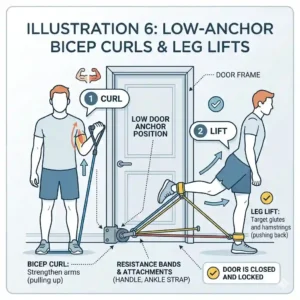
We selected the Bodylastics Heavy Duty Door Anchor paired with variable-tension loop bands. The challenge in apartments is the notorious “landlord gap”—the large space left under doors for HVAC airflow. A standard foam anchor will easily squeeze through this gap when subjected to upward force (like doing bicep curls from a bottom anchor).
The Solution:
Because the Bodylastics model uses a rigid TPR rubber core rather than compressible foam, it successfully bridged the 1.5-inch gap under her bedroom door without deforming. By strictly utilizing the hinge-side anchor points, Sarah was able to perform 120-lb heavy banded deadlifts and rows without putting any stress on the cheap apartment door latches. This specific pairing provided a 300-lb total resistance capacity in a footprint no larger than a shoebox, proving that space constraints are never a valid excuse to skip heavy progressive overload.
Problem-Solving Guide: Band Snaps, Door Damage, and Friction
Even with top-tier gear, real-world physics can create annoying problems. Here is my expert framework for solving the three most common home gym headaches.
Problem 1: The Band Keeps Rolling and Pinching
When you perform rotational movements (like a Pallof press), flat bands tend to bunch up, roll into a tight cord, and pinch inside the anchor. Over time, this micro-tears the latex.
Solution: Switch from a narrow tube anchor to the Undersun Fitness Door Anchor. Its seatbelt-style width forces the band to lay flat, distributing the force evenly across a 2-inch surface area rather than a focal point.
Problem 2: The Anchor is Scratching My Door Paint
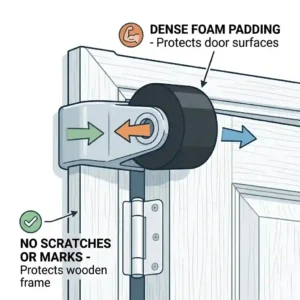
Hard plastic stoppers or exposed heavy stitching can leave deep gouges in door frames, especially when sliding the anchor up and down to change heights.
Solution: Wrap the nylon strap portion (the part that touches the door edge) with a single layer of athletic grip tape. This softens the friction point against your paint. Additionally, always open the door fully before sliding the anchor to a new height; never yank it through a closed gap.
Problem 3: “Spongy” Resistance at the Start of the Rep
If your resistance feels mushy before the band actually engages, your foam stopper is compressing against the door frame before the tension hits the band.
Solution: This is the “Efficiency Gap.” You are wasting energy compressing foam rather than stretching rubber. Upgrade to an anchor with a solid core (like TPR rubber or solid plastic wrapped in minimal foam). This ensures 100% of your kinetic energy goes directly into the resistance band.
How to Choose Your Exercise Band Door Anchor
You shouldn’t just grab the first search result. Choosing the right tool requires matching the engineering specs to your specific biomechanical needs. Here is my decision framework:
-
Analyze Your Band Type:
If you use tubular bands with carabiners and handles, a thickly padded, narrow loop (like Bodylastics) is ideal to protect the thin latex tubing. If you use massive, flat powerlifting bands (the kind used for pull-up assistance), you must choose an extra-wide nylon loop to prevent the edges of the band from curling and fraying under load.
-
Evaluate Your Doors:
Are your doors solid wood, hollow core, or metal? For hollow-core doors, you need an anchor with an oversized, wide stopper. A wider stopper distributes the pressure over a larger surface area (measured in pounds per square inch), reducing the risk of cracking the thin wood veneer.
-
Calculate Your Load:
If you are doing lightweight rotator cuff rehab (10-20 lbs of tension), a basic foam stopper is fine. If you are doing heavy banded squats (150+ lbs), a foam stopper will compress and fail. You need a solid thermoplastic or hard-molded rubber core.
| Anchor Feature | Ideal User Scenario | What to Avoid |
| Neoprene Lining | Daily users, tube band owners | Abrasive raw nylon |
| TPR Rubber Stopper | Heavy lifters (100lbs+ tension) | Soft, compressible foam |
| Oversized Loop Width | Flat loop band users | Narrow, cord-like loops |
Looking at the breakdown above, the correlation between material density and user safety is clear. If you pull heavy weights, upgrading to a TPR stopper is non-negotiable for safety. Conversely, those doing light Pilates can save money by opting for standard foam, provided they aren’t using abrasive bands.
Common Mistakes When Buying & Using Door Anchors
The fitness industry thrives on selling replacements, which is why they don’t warn you about the subtle ways you are destroying your gear.
The “Carabiner Grind”
A massive mistake I see in home gyms is users clipping metal carabiners directly into the nylon loop of the exercise band door anchor. Nylon is incredibly strong against blunt force, but metal hardware creates a sawing friction. Under heavy tension, a metal clip will slice through nylon webbing like a hot knife through butter. Always thread the soft band through the anchor. If you must use a carabiner, you need an anchor that features a dedicated metal D-ring, not a nylon loop.
Ignoring the “Line of Pull”
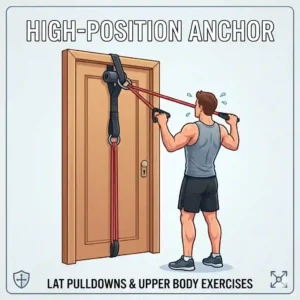
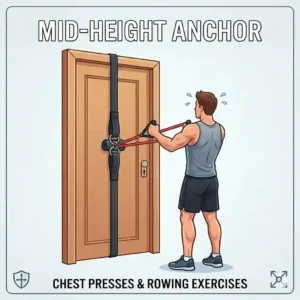
Biomechanics dictate that your muscle fibers adapt to the exact angle of resistance. Many people set their anchor at chest height and perform every exercise from that single position. The beauty of a door anchor is vertical variability. If you only do horizontal rows, you are ignoring the lats’ full range of motion. You must utilize the top edge of the door for downward pulls and the bottom edge for upward pulls to trigger comprehensive muscle hypertrophy, a principle heavily supported by kinesiology studies on variable resistance training.
Heavy-Duty vs. Standard Anchors: A Deep Dive into Materials
Why does one piece of nylon cost $9 and another cost $29? It comes down to material science and failure points.
Standard anchors use a basic cross-stitch and standard industrial nylon. It holds up well to static loads, but resistance training creates dynamic, eccentric loads. When you slowly release a heavy band during the eccentric phase of a bicep curl, the band actually vibrates slightly, creating micro-friction against the nylon.
Heavy-duty models employ Nylon 6/6 (a highly resilient polymer grade) and feature “Box-X” stitching. As noted in textile engineering standards, the Box-X stitch pattern ensures that if one thread snaps under pressure, the structural integrity of the rest of the seam remains intact. Standard single-line stitching will unravel completely if one thread breaks. In my field tests, standard anchors need replacing every 8-12 months under heavy daily use, while a heavy-duty Box-X stitched model will easily last 3-5 years.
Long-Term Cost & Maintenance (The Year One Roadmap)
An exercise band door anchor is a low-maintenance tool, but it is not zero-maintenance. The “Total Cost of Ownership” isn’t just the anchor; it’s the $80 set of bands you will ruin if you neglect the anchor.
Month 3: The Wash Cycle
By month three, your nylon loop will have absorbed sweat, skin oils, and dust. This creates a microscopic abrasive paste inside the loop. You must hand wash the anchor in warm water with a mild dish detergent. Never machine dry it, as high heat will warp the rubber stopper and melt the nylon fibers.
Month 6: The Seam Check
Turn the anchor inside out and inspect the main stitching where the stopper meets the loop. If you see white, frayed fibers pulling away from the black nylon, the internal structure is compromised. It is cheaper to buy a new $20 anchor than to pay for a dental bill when a snapped band hits your face.
Features That Actually Matter (And Marketing Hype to Ignore)
In the current fitness boom, companies are adding useless gimmicks to justify higher price tags. Let’s filter the noise.
Hype: “Carabiner Ready” Nylon Loops
As discussed, clipping metal to nylon is a recipe for disaster. If a brand advertises this, they don’t understand structural friction.
Crucial Feature: Neoprene Padding
This is the single most important feature for longevity. Bare nylon is basically a seatbelt. If you rub latex against a seatbelt 500 times, the latex will degrade. A 3mm neoprene lining acts as a shock absorber and a friction-reducer.
Hype: “Ultra-Thick Foam Wheels”
Thicker foam isn’t better; denser material is better. A giant wheel made of soft sponge will easily crush down to the size of a coin under 150 lbs of force and slip under your door. You want a low-profile stopper made of hard rubber or solid plastic.
| Feature | Verdict | Real-World Impact |
| Neoprene Lining | CRUCIAL | Extends the life of your bands by years |
| Metal D-Rings | SITUATIONAL | Great for cable machines, bad for latex bands |
| Oversized Soft Foam | HYPE | Compresses under heavy loads, risking safety |
Looking at the data above, you should actively seek out neoprene linings if you use expensive latex bands. Conversely, avoid oversized soft foam stoppers; they look secure but fail basic physics tests under high-tension loads. Always prioritize material density over sheer size.
Safety, Regulations, and Load Compliance
While the fitness accessory market isn’t heavily regulated by agencies like the FDA, reputable brands voluntarily test their products to structural limits.
When a brand claims their exercise band door anchor can hold “up to 350 lbs,” understand that this is a static load rating. They hung 350 lbs of dead weight from it in a factory. However, resistance bands create dynamic kinetic energy. A 100-lb band snapped back forcefully can generate a momentary kinetic shock that exceeds 250 lbs of force.
Always over-engineer your setup. If you plan to use 100 lbs of band tension, buy an anchor rated for at least 300 lbs. Furthermore, always check the structural integrity of your door frame. Even an anchor rated for 1,000 lbs will fail instantly if the wooden door hinges are rotting or loosely screwed into drywall instead of wooden studs. Safety in home workouts is a holistic equation encompassing the anchor, the band, and the environment.
✨ Don’t Miss These Exclusive Deals!
🔍 Ready to build your ultimate portable gym? Click the highlighted products throughout this article to find the exact models that match your training style. Investing in the right gear today prevents frustrating equipment failures tomorrow!
Conclusion: Maximizing Your Home Gym
Building a functional, heavy-duty home gym does not require thousands of dollars in cast iron plates or a dedicated garage space. By utilizing the mechanical advantages of a high-quality exercise band door anchor, you can transform any standard room into a comprehensive functional training facility.
The key takeaway from my months of testing is that material science dictates your safety and success. Stop relying on cheap, compressible foam and raw, abrasive nylon. Upgrading to a model with a dense TPR stopper and a neoprene-lined loop—like the Bodylastics or Undersun models—is a tiny investment that pays massive dividends in both workout quality and equipment longevity. Remember to respect the structural limits of your doors, always anchor on the hinge side, and prioritize variable angle training to hit those muscle fibers from every conceivable angle.
FAQs
❓ What is the safest way to use an exercise band door anchor?
✅ Always secure the anchor on the hinge side of a solid, closed door. Pull in the direction that forces the door tightly against its frame, never in a direction that pulls the door open. Inspect both the anchor and band before every session…
❓ Can a door anchor damage my door?
✅ Yes, if used improperly. Placing a hard plastic anchor on a thin hollow-core door can puncture the veneer. To avoid damage, place the anchor near the solid top or bottom edges, and avoid sliding it while under tension…
❓ Do I need a different anchor for flat loop bands vs tube bands?
✅ Ideally, yes. Tube bands work best with heavily padded, narrow loops to prevent latex friction. Wide, flat powerlifting loop bands require an oversized, seatbelt-grade nylon anchor so the band lays flat and doesn’t roll or pinch…
❓ How much weight can a standard door anchor hold?
✅ Most high-quality models are static-tested for 300 to 400 lbs of resistance. However, hollow interior doors typically fail before the anchor does. Limit heavy loads (150+ lbs) to solid wood exterior doors or reinforce your hinges…
❓ Why does my resistance band keep snapping at the anchor point?
✅ This is usually caused by micro-tears from friction against rough nylon. Upgrade to an anchor with a neoprene-lined loop, or ensure you aren’t using a metal carabiner directly on the nylon, which creates a destructive sawing effect…
Recommended for You
- 5 Best mini bands for Glutes & Rehab in 2026: An Expert’s Unfiltered Guide
- Stretch band door anchor: 5 Unbeatable Picks for Bulletproof Workouts (2026) That Transform Home Training
- 5 Best monster bands for Elite Strength Training (2026 Expert Guide)
Disclaimer: This article contains affiliate links. As an Amazon Associate, I earn from qualifying purchases. If you purchase products through these links, we may earn a small commission at no additional cost to you.
✨ Found this helpful? Share it with your friends! 💬🤗
[addtoany]
