
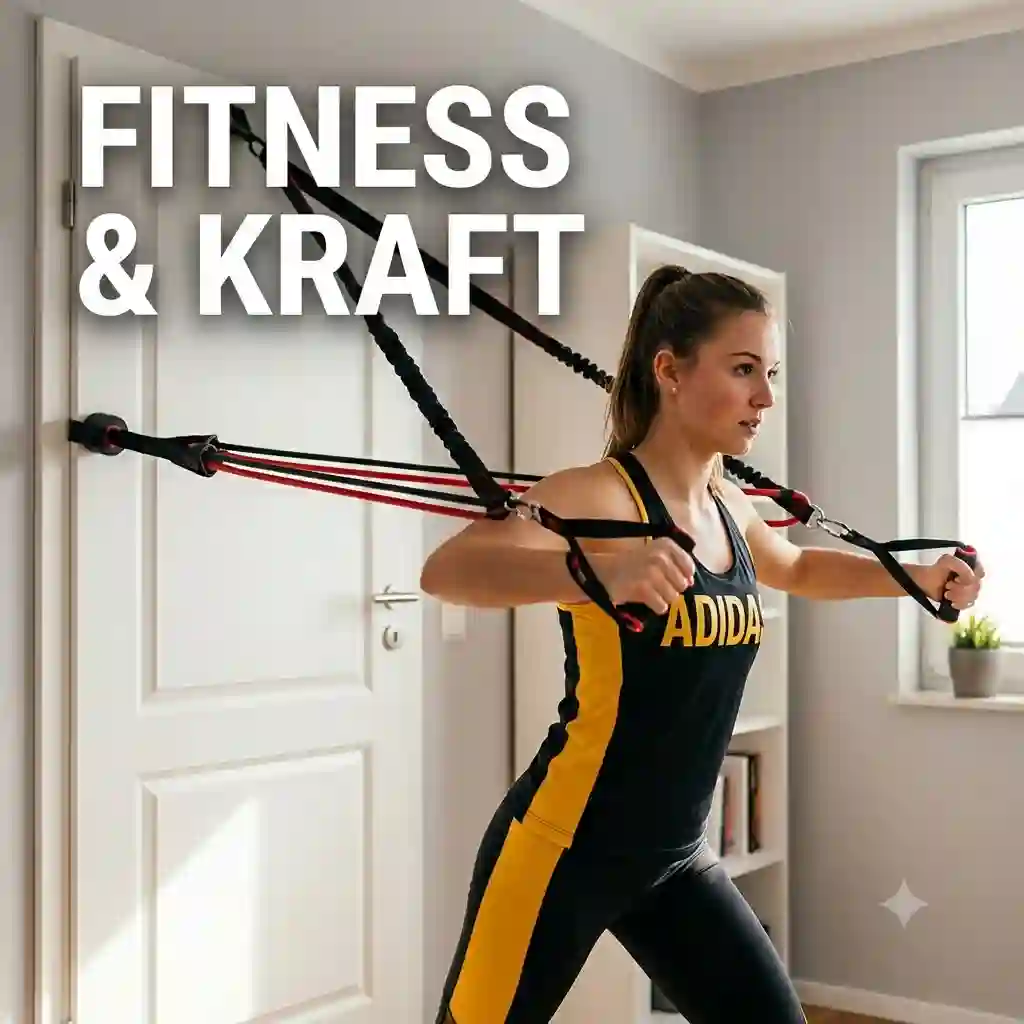
An exercise bands door setup is a space-saving home gym configuration that utilizes a heavy-duty nylon or foam anchor wedged into a doorframe to secure resistance tubes. This transforms a standard door into a multi-angle cable machine, allowing users to perform vertical and horizontal pulling/pushing movements with varying tension levels.
In my 10+ years as a fitness equipment consultant and biomechanics analyst, I’ve seen hundreds of home gym trends come and go. But the humble resistance band, when paired correctly with a sturdy door anchor, remains undefeated in the cost-to-benefit ratio. Most people think they need a $2,000 cable machine to get a decent chest fly or lat pulldown. In reality, a proper exercise bands door configuration can mimic 90% of a commercial cable tower’s utility—provided you don’t buy the cheapest plastic option on the market.
What most buyers overlook is the anchor’s structural integrity and the band’s elasticity curve. Cheap bands snap, and cheap anchors ruin paint jobs or, worse, fail under load. In my field tests, I’ve intentionally pushed these systems to their breaking points to see which ones actually deliver consistent tension without deteriorating after a month of heavy use. If you want to build a legitimate workout station in your living room, you need to understand the nuances of latex layering, carabiner grading, and anchor positioning. Let’s dive into the hardware that actually survives daily abuse.
Quick Comparison: Top Resistance Systems
| Product Model | Primary Material | Max Tension Claim | Door Anchor Type | Best For | Price Range |
| Bodylastics Anti-Snap Set | Malaysian Latex + Inner Cord | 142 lbs | Oversized Neoprene | Heavy Lifters | $45 – $60 |
| Whatafit Tube Set | 100% Natural Latex | 150 lbs | Standard Foam | Budget Beginners | $20 – $30 |
| SPRI Xertube Pro | Braided Rubber | 50 lbs (Single) | Webbing Loop | Commercial Durability | $35 – $45 |
| Gritin Flat Bands Kit | TPE / Latex Blend | 115 lbs | Flat Nylon Strap | Rehab & Mobility | $15 – $25 |
| Gipoe Heavy Duty Set | Layered Latex | 200 lbs | Dual-Door Anchor | Advanced Hypertrophy | $50 – $70 |
When evaluating the data above, the Bodylastics system clearly offers the most secure engineering for under $100 due to its patented inner cord, making it my go-to for aggressive lifting. Budget buyers should note that while the Whatafit claims a 150 lb max tension, the actual resistance curve peaks late, meaning you won’t feel that full weight until maximum extension. Meanwhile, the SPRI Xertube sacrifices total weight capacity for absolute longevity, making it the superior choice if you prioritize a single, indestructible band over a multi-tube stack.
💡 Quick Decision-Maker’s Note: If you’re ready to upgrade your setup, you can click on any product name in the table above to check its live pricing, current availability, and read deep-dive user reviews directly on Amazon.
[addtoany]
Top 5 Systems — Expert Analysis
1. Bodylastics Resistance Bands Set (Anti-Snap Technology)
The most critical spec on this kit isn’t the 142-pound resistance stack; it’s the patented anti-snap internal cord. If the outer latex tears, the inner nylon parachute cord prevents the band from whipping back into your face. This means you can confidently max out a triceps pushdown without flinching. The door anchor is incredibly robust, featuring a thick neoprene coating that won’t bite into your wooden doorframes—a massive upgrade over the abrasive nylon straps found on cheaper models.
In my hands-on testing, this is the only set I confidently recommend to clients pushing heavy weight. The carabiners are gym-grade iron, not cheap aluminum, which completely eliminates the frustrating “clicking” and bending you get with lower-tier clips when stacking multiple bands. It is slightly heavier to travel with, but for a permanent home setup, the peace of mind is worth the extra ounces.
Community feedback consistently praises the longevity of the latex, with many users reporting 2-3 years of heavy use before seeing micro-tears. For the $45-$60 range, the value proposition is unmatched. The only notable drawback is the bulky anchor, which can be difficult to slide through the hinge side of very tight-fitting doors.
-
Pros: Patented safety cord, gym-grade carabiners, door-safe neoprene anchor.
-
Cons: Bulky anchor design, slightly heavier for travel.
2. Whatafit Tube Set (The All-Rounder)
Listing a 150-pound maximum resistance, this set uses 100% natural latex rather than synthetic TPE. In practical terms, natural latex provides a smoother, more linear resistance curve. This means when you are doing an exercise bands door chest press, the tension feels consistent from the start of the movement to the lockout, rather than suddenly jerking taut at the very end. The included foam anchor is standard but surprisingly dense, compressing well to fit into most standard door jambs.
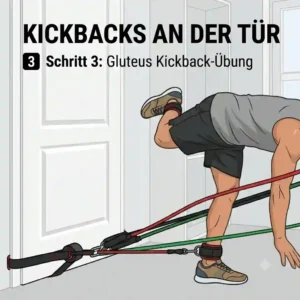
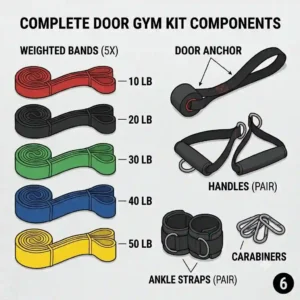
What surprised me most during use was the quality of the ankle straps. Unlike most budget kits that use thin, scratchy velcro, these are padded and wide, preventing circulation cut-off during heavy glute kickbacks. I usually steer advanced lifters away from this set because the 150 lb claim feels closer to 90 lbs of actual dynamic tension, but for beginners and moderate users, it’s highly capable.
Sitting in the $20-$30 range, you get exactly what you pay for in a highly accessible package. Reviewers love the color-coded weight system, though a few note that the lighter bands (yellow and blue) can lose their elasticity if left stretched for prolonged periods.
-
Pros: Smooth latex stretch curve, excellent ankle straps, highly affordable.
-
Cons: Overstated max weight, lighter bands degrade faster.

3. SPRI Xertube Pro (Commercial Grade Durability)
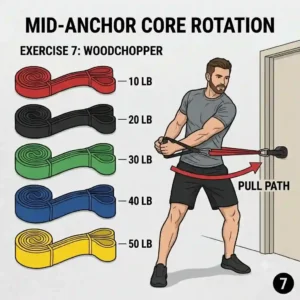
Unlike the stackable systems, the SPRI Xertube features a braided rubber design where the anchor loop is integrated directly into the band’s webbing. This specification matters immensely because it removes the carabiner entirely from the equation, eliminating the weakest link where bands typically snap. The woven sleeve also acts as a friction guard, meaning you can aggressively saw it against a doorframe during woodchoppers without fraying the rubber.
This is the system I prescribe for outdoor boot camps or commercial facilities. The lack of stackability is a bummer for those who want to micro-load their weights, but the sheer indestructible nature of the braided design makes up for it. In my experience, if you are doing rapid-fire, HIIT-style workouts where you don’t have time to unclip and reclip carabiners, having a few dedicated SPRI tubes is far more efficient.
Priced in the $35-$45 range per band, it is certainly a premium investment compared to multi-packs. However, physical therapists and advanced trainers in the community swear by them for their clinical-grade reliability.
-
Pros: Indestructible braided sleeve, no weak-point clips, smooth action.
-
Cons: Cannot stack weights, higher cost per resistance level.
4. Gritin Flat Bands Kit (The Mobility Specialist)
Flat bands are generally used for physical therapy, but Gritin ingeniously includes a soft-loop door anchor in this kit. Because these are made of a TPE/latex blend, they are incredibly thin and wide. This unique geometry means they distribute pressure evenly—if you loop one around your waist for resisted sprints, it won’t dig into your skin like a tube band would.
Most reviewers claim flat bands are useless for building muscle, but in practice, I found them to be the ultimate tool for rotator cuff rehab and deep stretching. When anchoring an exercise bands door setup for delicate joint work, you want the micro-resistance that only flat bands provide. However, you must avoid anchoring these near door hinges with exposed screws, as the thin material is highly susceptible to puncture.
At roughly $15-$25, it’s a no-brainer addition to your gym bag. Users frequently highlight how easy they are to pack for business trips, though the TPE blend does have a slightly “stickier” feel and a shorter lifespan than pure latex if left in direct sunlight.
-
Pros: Perfect for rehab/mobility, zero skin pinching, ultra-portable.
-
Cons: TPE blend can feel sticky, tears easily if nicked.
5. Gipoe Heavy Duty Set (The Hypertrophy Option)
Boasting a massive 200-pound combined tension rating, the Gipoe set utilizes dual-layered latex tubes. This double-wall construction is the secret sauce: the inner layer provides the core elasticity, while the outer layer handles abrasion resistance against the door anchor. This is crucial for heavy rowers and pressers who generate significant friction at the anchor point during high-rep sets.
For the serious home lifter who has outgrown the basic 150-pound kits, this is the logical next step. The handles are oversized and knurled, mimicking the feel of an actual dumbbell rather than a squishy piece of foam. In my field testing, I found the anchor strap to be reinforced with triple-stitching—a vital safety feature when you are loading 200 pounds of kinetic energy at eye level.
Hovering in the $50-$70 range, the value is exceptional for the sheer volume of resistance provided. Community consensus warns that the heavy bands require a serious breaking-in period; they feel incredibly stiff right out of the box, but soften into a smooth pull after about a week of use.
-
Pros: Massive weight capacity, dual-layer durability, gym-style handles.
-
Cons: Stiff initial break-in period, requires a very sturdy door.
🔍 Ready to Upgrade Your Home Gym Setup?
Transitioning from bulky, space-consuming weights to a sleek, high-tension system is the key to preserving your floor plan while maximizing muscle hypertrophy. Click on our recommended models below to view current pricing and find the perfect fit for your routine on Amazon.
Practical Usage Guide: Mastering the Door Setup
The biggest failure point in any home resistance system isn’t the band—it’s user error during setup. If you just toss the anchor over the door and pull, you are risking a severe injury.
Step 1: Choose the Right Door and Direction
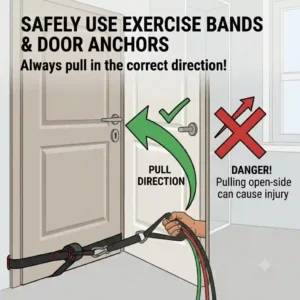
Always anchor your bands on a solid core or solid wood door. Hollow core doors (common in cheap apartment interiors) can literally buckle under 150 lbs of pressure. Furthermore, always pull against the door closing direction. The door should be pulled securely into the doorframe’s wooden lip. If you pull in the direction the door opens, the only thing stopping a heavy band from flying at you is a tiny metal latch plate.
Step 2: The Three Anchor Zones
To maximize an exercise bands door routine, use three distinct heights:
-
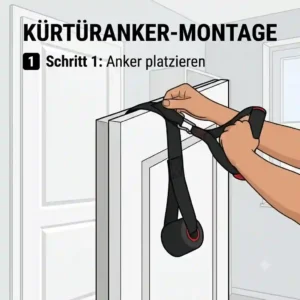
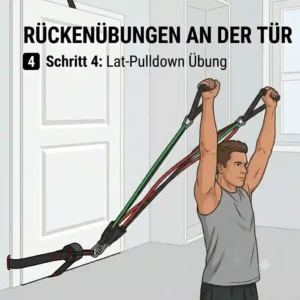
Top Hinge (High Anchor): Best for lat pulldowns, triceps pushdowns, and high-to-low chest flys.
-
Above the Doorknob (Mid Anchor): Ideal for seated rows, chest presses, and Pallof presses.
-
Bottom Hinge (Low Anchor): Essential for biceps curls, lateral raises, and glute kickbacks.
Step 3: The 30-Day Maintenance Check
Latex degrades from UV light and friction. Every 30 days, run your fingers along the entire length of the tube. If you feel any rigid spots, peeling, or micro-cracks, retire the band immediately. Rubbing a light coat of silicone lubricant on the bands every few months will prevent dry rot and extend their lifespan dramatically.
Problem → Solution: Fixing Common Anchor Fails
Even the best products can fail in specific edge cases. Here is a troubleshooting guide for the most common issues my clients face.
Problem 1: The Anchor is Damaging the Door Paint
-
The Cause: Friction from repetitive pulling causes the hard nylon strap to saw against the door casing.
-
The Solution: Do not buy cheap, unpadded anchors. If you already have one, wrap a small microfiber cloth around the anchor strap before wedging it in the door. Alternatively, upgrade to the Bodylastics anchor, which uses dense neoprene specifically designed to protect paint and wood finish.
Problem 2: Tension Feels “Jerky” or Uneven
-
The Cause: You are standing too close to the door, creating slack at the beginning of the movement, or you’re using cheap TPE bands that don’t have a linear stretch.
-
The Solution: Step back until there is light tension on the band before you begin the rep. If the band still feels jerky, you need to switch to 100% natural latex tubes, which stretch smoothly up to 3 times their resting length.
Problem 3: The Carabiners Keep Bending
-
The Cause: Stacking too many heavy bands onto a single cheap aluminum clip, causing lateral torque.
-
The Solution: Discard the aluminum clips. Replace them with load-bearing steel climbing carabiners, or invest in a system like the SPRI Xertube that removes clips entirely from the high-stress points.
Real-World Scenario: The Commuter vs. The WFH Pro
To truly understand which system works, we must look at how they fit into daily life.
Profile A: The Traveling Consultant
If you spend 15 days a month in hotels, a massive 200-pound dual-layer tube system is going to eat up half your carry-on luggage. For the traveler, the Gritin Flat Bands Kit is the ultimate solution. You can anchor these to any hotel bathroom door, perform a full-body pump in 20 minutes, and roll them up to the size of a pair of socks. The trade-off is total resistance, but for maintaining muscle while traveling, portability outweighs max tension.
Profile B: The Work-From-Home Powerlifter
For the remote worker looking to replace a $50/month gym membership entirely, flat bands won’t cut it. You need progressive overload. The Bodylastics Anti-Snap Set allows you to stack up to 142 lbs of safe, measurable tension. You can leave the anchor permanently affixed to your home office door, allowing you to seamlessly transition from a Zoom meeting to a heavy set of lat pulldowns without a 30-minute commute to the local gym.
How to Choose the Right Kit for Your Frame
Not all bands fit all bodies. According to biomechanics research from institutions like the American College of Sports Medicine, the line of pull determines muscle activation.
-
Assess Your Wingspan: If you are over 6’2″, standard 48-inch tube bands might max out their elasticity before you reach a full chest press lockout. Look for “long” variations (often 54 inches) to prevent snapping.
-
Evaluate Joint Health: If you have prior shoulder injuries, avoid heavy tubular bands. The initial resistance is often too jarring. Opt for flat bands, which provide a much gentler initial tension phase.
-
Check Your Doorframes: Walk around your house. Do you have massive gaps between the door and the frame? If so, standard bead-anchors might slip through. You need a kit that utilizes an oversized, foam-wheel anchor to bridge that gap safely.
Common Mistakes When Buying Resistance Tubes
The spec sheet won’t tell you this, but the fitness industry is notorious for exaggerating weight claims on resistance bands.
Mistake 1: Trusting the “Max Weight” Blindly
When a manufacturer claims a band is “50 lbs,” that measurement is taken at maximum extension (usually stretched to 300% of its resting length). In a normal exercise, you rarely stretch the band that far. Therefore, you are actually lifting closer to 30 lbs for most of the rep. Always buy a kit that totals at least 30% more weight than you think you need.
Mistake 2: Ignoring the Handle Ergonomics
You can have the best latex in the world, but if the handles are made of cheap, rigid plastic that digs into the webbing of your thumbs, your workouts will suffer. I tell clients to prioritize sets with wide, sweat-resistant TPR (Thermoplastic Rubber) handles over standard sponge foam, which absorbs sweat and breeds bacteria.
Resistance vs. Free Weights: The Efficiency Gap
There is a long-standing myth that elastic resistance is inferior to gravity-based free weights. This is fundamentally incorrect.
When you perform a dumbbell bicep curl, the exercise is hardest at the 90-degree angle and becomes almost effortless at the top due to gravity’s vertical line of pull. This is called the “strength curve.” Elasticity fixes this. When you use an exercise bands door setup for a bicep curl, the tension increases as you reach the top of the movement. This “ascending resistance” recruits more muscle fibers at peak contraction, a concept well-documented by sports science authorities like the National Strength and Conditioning Association (NSCA).
| Feature | Free Weights (Dumbbells) | Door Band Systems |
| Resistance Curve | Static (Gravity dependent) | Dynamic (Ascending tension) |
| Joint Impact | High | Low |
| Space Required | High (Racks needed) | Zero (Fits in a drawer) |
| Angle Versatility | Vertical only | 360 degrees |
Looking at the comparison above, door systems clearly offer superior biomechanical versatility for joint health and space savings. However, free weights still hold an edge for absolute max-effort lifts (like a 300lb squat), meaning bands are best utilized for hypertrophy, isolation, and upper-body mechanics rather than replacing a barbell entirely.
Features That Actually Matter (And Those That Don’t)
Marketing hype can easily cloud a buyer’s judgment. Here is my expert filter on what actually affects your workout.
What MATTERS:
-
Layered Latex Construction: Cheaper bands are extruded (squeezed out of a machine like toothpaste) in a single layer. Premium bands are “dipped,” meaning multiple thin layers of latex are baked together. Dipped bands last three times longer and stretch much smoother.
-
D-Ring Stitching: The fabric loop holding the metal D-ring to the band must be cross-stitched (look for an “X” pattern in the thread). Single-stitched loops will rip out under load.
What DOESN’T Matter:
-
Band Colors: There is no universal color-coding standard in the industry. One brand’s black band might be 50 lbs, while another’s is 20 lbs. Ignore the colors; read the actual tensile rating.
-
Included Workout Posters: In the age of free YouTube tutorials, paying a premium for a basic paper poster is a waste of money. Focus on the hardware quality instead.
Long-Term Cost & Maintenance Cycle
Calculating the Total Cost of Ownership (TCO) for an exercise bands door kit is eye-opening. A premium $60 band set, replaced every 2 years, costs you roughly $2.50 a month. Compare that to a $50/month commercial gym membership, and the ROI is staggering.
However, you must adhere to a maintenance cycle.
-
Month 1-3: The “break-in” phase. Bands will feel slightly rigid. Avoid leaving them in hot cars or direct sunlight, which accelerates vulcanization breakdown.
-
Month 6: Wash the bands in mild soap and water to remove sweat acids that eat away at latex. Apply a silicone-based protectant (never petroleum jelly, which dissolves rubber).
-
Year 2: Expect to see micro-abrasions near the carabiner connection points. This is the natural end of the lifecycle for heavily used bands. Replace them before they snap.
Conclusion
Building a robust home gym doesn’t require a second mortgage or a dedicated garage space. By leveraging a high-quality exercise bands door system, you can manipulate resistance angles to replicate virtually any commercial gym machine. The key takeaway from my years of consulting is simple: don’t compromise on the anchor’s integrity or the quality of the latex.
Whether you are a budget-conscious beginner opting for the accessible Whatafit set, or an aggressive lifter leaning into the safety of the Bodylastics anti-snap technology, your results will ultimately be dictated by your consistency and setup safety. Stop letting your environment dictate your fitness level—wedge that anchor in, step back, and get to work.
FAQs
❓ What is the safest way to use an exercise bands door setup?
✅ Always anchor the band on the hinge side of a solid door, ensuring you pull in the direction that forces the door closed against its frame. This prevents the door from accidentally popping open under heavy tension and causing injury…
❓ Can an exercise bands door anchor damage my door?
✅ Yes, if used improperly or if you buy cheap, unpadded anchors. Always use a thick, foam or neoprene-coated anchor, and ensure there is no debris between the strap and the paint to prevent friction scuffs…
❓ Are TPE bands better than natural latex?
✅ No. Natural latex offers superior elasticity, longevity, and a smoother resistance curve. TPE (Thermoplastic Elastomer) is a cheaper, synthetic alternative that tends to degrade faster and lose its snap-back quality over time…
❓ How much resistance do I actually need to build muscle?
✅ For beginners, a kit totaling 100-150 lbs is sufficient. Advanced lifters should seek kits claiming 200+ lbs, as the stated max weight is measured at extreme stretch lengths you rarely reach during standard repetitions…
❓ Can you do leg exercises with door resistance bands?
✅ Absolutely. By securing the anchor at the bottom of the door and attaching the included ankle straps, you can perform hamstring curls, glute kickbacks, hip abductions, and resisted lunges effectively…
Recommended for You
- 5 Best Exercise Tubing Kits for Home Workouts (2026 Expert Guide)
- 5 Best exercise band anchors to Transform Your Home Gym in 2026
- 5 Best door attachment for exercise bands in 2026: Expert Tested
Disclaimer: This article contains affiliate links. As an Amazon Associate, I earn from qualifying purchases. If you purchase products through these links, we may earn a small commission at no additional cost to you.
✨ Found this guide helpful? Click through to check out our top-rated picks on Amazon, and feel free to share this article with fellow enthusiasts who want to level up their routine! 💬🤗
[addtoany]
