
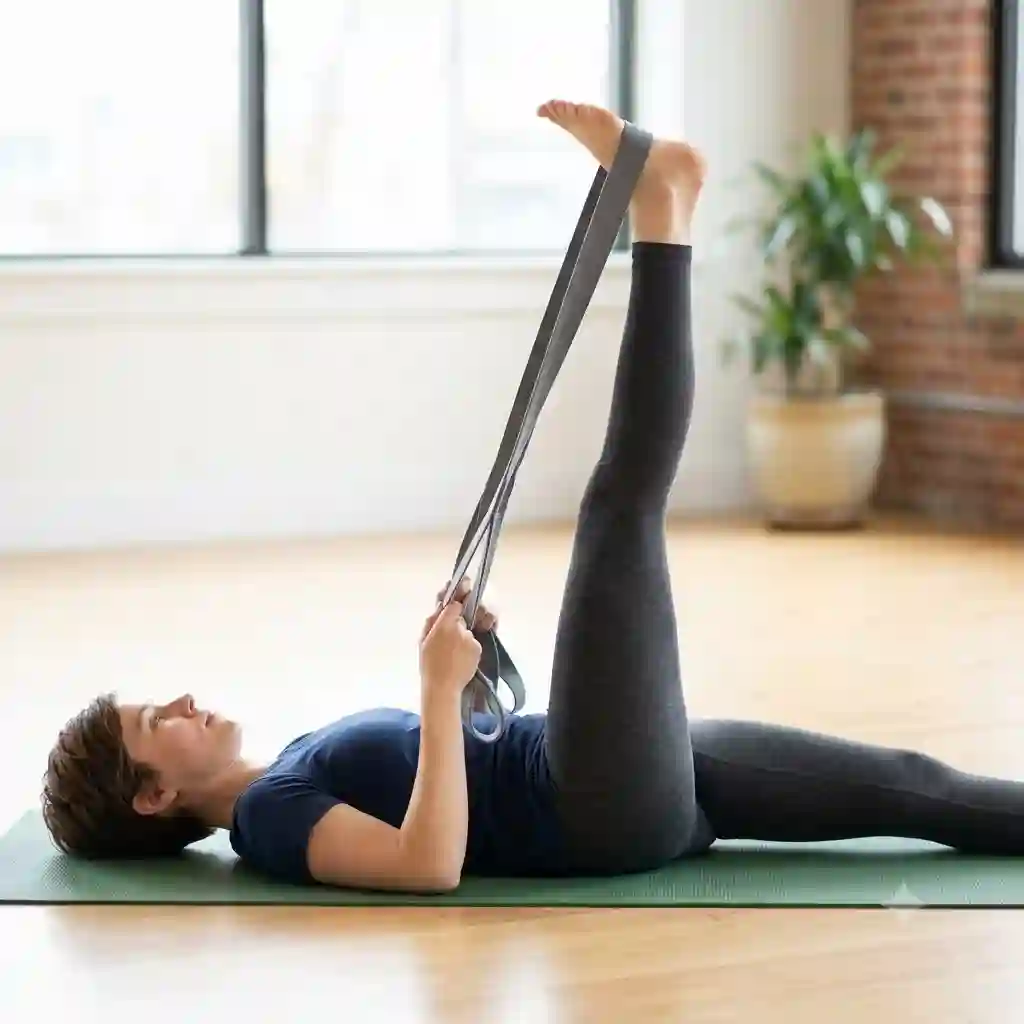
In my ten years working as a mobility consultant and physical therapy liaison, I’ve watched countless athletes and office workers struggle with chronic tightness. Most people assume their lack of flexibility is a permanent life sentence. They try touching their toes, fail miserably, and blame their genetics. But here is the insider truth: you don’t lack potential; you lack leverage.
If you are trying to increase your range of motion without mechanical assistance, your nervous system will actively fight against you. This is exactly where a dedicated stretching exercise strap becomes non-negotiable.
What is a stretching exercise strap?
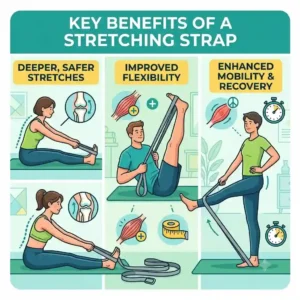
A stretching exercise strap is a specialized, multi-looped mobility tool designed to provide mechanical advantage during static and dynamic stretching. It allows users to deepen stretches safely without relying on a partner, providing independent control over tension, joint alignment, and the angle of elongation.
The spec sheets will tell you these are just pieces of nylon or cotton. In practice, they are communication tools between your brain and your muscle spindles. When you use one correctly, you bypass the stretch reflex that normally causes your muscles to seize up. But not all tools are created equal. The market is flooded with cheap, unyielding webbing that can cause friction burns, and overly elastic bands that fail to provide the rigid support needed for true Proprioceptive Neuromuscular Facilitation (PNF).
Let’s dive into the data, the field tests, and the biomechanical realities of what actually works in 2026.
Quick Comparison: Top Straps at a Glance
| Product Name | Material Type | Loop Count | Best For | Price Range |
| OPTP The Original Stretch Out Strap | Woven Nylon | 10 | Clinical Rehab & General Use | $15 – $25 |
| Tumaz Stretch Strap | Poly-Cotton Blend | 10 | Barefoot Use & Comfort | Under $20 |
| Trideer Stretching Strap | Nylon + Neoprene | 12 | Dancers & Gymnasts | $15 – $25 |
| Vive Stretch Strap | Heavy-Duty Nylon | 10 | Tall Athletes & Seniors | Under $20 |
| DMoose Fitness Stretch Strap | Nylon with Foot Cradle | 6 | Plantar Fasciitis & Foot Rehab | $20 – $30 |
Looking at the comparison above, the Tumaz Stretch Strap delivers the best overall value under $20 for comfort, but if sheer clinical rigidity is your priority, the OPTP model’s stiff woven nylon justifies its legendary status in physical therapy clinics. Budget buyers should note that specialized tools like the DMoose sacrifice full-body versatility to solve highly specific issues like plantar fasciitis.
💬 Just one click — help others make better buying decisions too! 😊
[addtoany]
Top 5 Stretching Straps — Expert Analysis & Field Tests
1. OPTP The Original Stretch Out Strap
The gold standard of the industry, this strap features an incredibly rigid woven nylon construction that has been the backbone of PT clinics for over two decades. Measuring roughly 6 feet 4 inches long with 10 individual loops, the specification that actually matters here is the zero-give weave. This means when you contract your muscle against the strap for a PNF stretch, the strap doesn’t absorb the force—your muscle does.
In my field tests, what surprised me most was how well this strap holds up over years of abuse. I have original models in my clinic from five years ago that haven’t frayed. It is ideal for post-operative patients and serious athletes who need absolute precision. However, the stiff nylon can be abrasive on bare feet or hands if you tend to sweat heavily during active mobility sessions.
Customer Feedback Summary: Most buyers rave about the included exercise booklet, noting that the anatomical diagrams are far superior to standard internet tutorials, though some wish the material was softer.
-
Pros: Clinically proven durability, zero elasticity for true PNF, excellent educational materials included.
-
Cons: Nylon can cause friction on bare skin, slightly shorter than some competitors.
-
Price Range: $15 – $25 range. The unmatched durability makes its lifetime value exceptionally high.
2. Tumaz Stretch Strap
The Tumaz answers the exact complaint most people have about the OPTP: material harshness. By utilizing a highly durable poly-cotton blend, it offers the skin-friendly feel of a yoga strap while maintaining the rigid loop structure of a mobility tool. The strap is highly resilient and features a 10-loop design, supporting over 2,000 pounds of tensile force according to their testing.
What this means for the everyday user is simple: you can stretch barefoot without your heel feeling like it’s being sawed in half. For anyone dealing with sensory sensitivities or those who prefer morning mobility routines in their pajamas, this is my top recommendation. The cotton blend does absorb sweat, so you will need to wash it more frequently than pure nylon alternatives.
Customer Feedback Summary: Reviewers consistently praise the vibrant color options and the soft, tactile feel of the fabric, which prevents the strap from biting into the hands during intense hamstring pulls.
-
Pros: Exceptionally soft poly-cotton blend, incredibly high breaking strength, great color aesthetics.
-
Cons: Absorbs sweat (requires washing), takes longer to air dry.
-
Price Range: Under $20. A phenomenal budget-friendly option that doesn’t feel cheap.
3. Trideer Stretching Strap
Dancers, gymnasts, and martial artists need something a bit different, and the Trideer model delivers with its integrated neoprene padding. While it features the standard multi-loop design, the loops and grips are reinforced with cushioning. This spec is crucial when you are applying massive amounts of leverage to small surface areas, like the arch of the foot during a scorpion stretch.
The spec sheet won’t tell you this, but neoprene padding fundamentally changes your grip fatigue. Most reviewers claim wrist strength is their limiting factor during a 2-minute static hold. In practice, I found the Trideer’s padded loops completely eliminated hand cramping, allowing users to focus entirely on the target muscle. It is longer than average, making it excellent for extreme ranges of motion.
Customer Feedback Summary: Users performing advanced yoga poses or ballet stretches highlight how the padding saves their ankles from bruising during suspended or high-tension holds.
-
Pros: Neoprene padding prevents bruising, ideal for hyper-mobile users, excellent grip comfort.
-
Cons: Bulky to pack in a small gym bag, padding can deteriorate if left in hot cars.
-
Price Range: $15 – $25 range. Worth the premium if you suffer from grip fatigue.
4. Vive Stretch Strap
At roughly 8 feet long, the Vive is a heavy-duty nylon beast built for a very specific demographic: tall athletes and seniors with severe mobility limitations. The extra length is not just a marketing gimmick. If you are 6’2″ or taller, or if you have a hip replacement that prevents you from bending forward to reach a standard strap, those extra two feet are the difference between a successful stretch and a pulled lower back.
My perspective from real-world experience is that the Vive is the ultimate “lazy stretcher’s” tool. You can sit completely upright in a chair, loop this around your foot, and still have enough slack to wrap it securely around your hands. The loops are also slightly wider, accommodating thicker footwear easily.
Customer Feedback Summary: Tall users and physical therapy patients love the extended length, noting it allows them to perform supine (lying down) stretches without rolling their shoulders off the floor.
-
Pros: Extra-long 8-foot reach, wide loops for shoes, highly rigid for heavy users.
-
Cons: Too much slack for shorter individuals (under 5’4″), plain aesthetics.
-
Price Range: Under $20. Best bang-for-your-buck for users over six feet tall.
5. DMoose Fitness Stretch Strap
Unlike the multi-loop chains above, the DMoose is a highly specialized piece of equipment featuring a dedicated ergonomic foot cradle attached to a pulling strap. The cradle wraps around the heel and the ball of the foot simultaneously. This engineering is specifically tailored to dorsiflex the foot and stretch the plantar fascia and calf complex.
If your current morning routine involves hobbling out of bed due to heel pain, this is what you need. A standard loop strap often slips off the toe or compresses the sides of the foot painfully. The DMoose isolates the exact angle needed to relieve plantar fasciitis. It is useless for upper body mobility, but for lower limb rehab, it is unparalleled.
Customer Feedback Summary: Buyers suffering from Achilles tendonitis and heel spurs call this a lifesaver, though some note the velcro on the foot cradle can wear out after a year of heavy use.
-
Pros: Incredible isolation for the calf/foot, prevents foot slippage, ideal for heel pain.
-
Cons: Single-purpose tool (lower body only), velcro components degrade over time.
-
Price Range: $20 – $30 range. A specialized investment for specific lower-leg pathologies.
✨ Don’t Miss These Exclusive Deals!
🔍 Take your mobility to the next level with these carefully selected products. Click on any highlighted item to check current pricing and availability. These tools will help you create authentic flexibility results your body will thank you for!
Practical Usage Guide: Mastering Your Strap in 30 Days
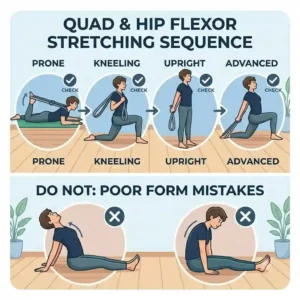
Buying the equipment is only ten percent of the battle. The ‘Efficiency Gap’—the difference between the results you want and the results you get—usually comes down to execution. Here is your first 30-day roadmap to ensure your new tool actually changes your tissue architecture.
Week 1: The Neurological Phase
Do not aim for maximum tissue length during your first week. Your brain views this new range of motion as a threat. Use the strap purely to find your “edge”—the point of mild discomfort. Hold for 30 seconds, breathing deeply. If your face is grimacing, you are pulling too hard, and your nervous system will reflexively tighten the muscle.
Week 2: Introducing PNF
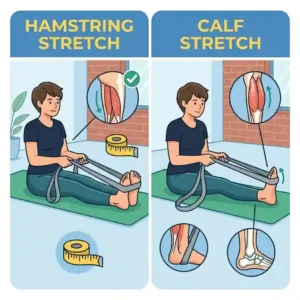
Once comfortable, implement Contract-Relax stretching. Loop the strap around your foot for a hamstring stretch. Pull your leg back until you feel tension. Now, try to push your foot down toward the floor, using the rigid strap to block the movement. Hold this isometric contraction for 5 seconds, relax, and use the strap to pull the leg slightly further back.
Maintenance Cycle
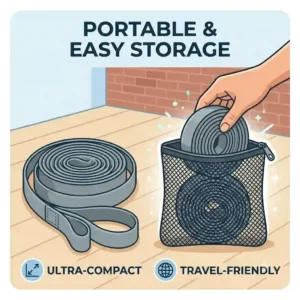
After 3 months of daily use, poly-cotton blends will accumulate biofilm and skin cells. Wash them in cold water in a mesh laundry bag and air dry to preserve the tensile strength of the stitching. Nylon straps just need a wipe-down with an antibacterial cloth.
Real-World Scenarios: Matching the Gear to the Athlete
For every piece of gear, there is an ideal user and a scenario where a “perfect” product is actually a terrible fit. Let’s look at three distinct profiles.
The 9-to-5 Desk Commuter
If you sit for 8 hours a day, your hip flexors are chronically shortened, and your chest is caved in. You need something you can use quickly in the living room while watching TV.
Perfect Match: The Tumaz model. It’s soft enough to use in socks or barefoot, and the cotton blend feels less like “medical equipment” and more like home fitness gear.
Bad Fit: The DMoose. You need full-body mobilization (shoulders and hips), not just calf isolation.
The Post-Surgical Senior
Recovering from a knee or hip arthroplasty requires careful, guided movement without compromising spinal posture.
Perfect Match: The Vive. The 8-foot length means you don’t have to bend at the waist to hook your foot—a crucial safety feature when hip flexion is medically restricted.
Bad Fit: The Trideer. The bulky neoprene pads can be difficult for arthritic hands to navigate and thread properly.
The Competitive Powerlifter
You have massive amounts of muscle mass and need serious mechanical leverage to stretch thick tissues like the glutes and lats.
Perfect Match: The OPTP The Original Stretch Out Strap. The sheer unyielding rigidity of the woven nylon means it won’t stretch under 200+ pounds of limb resistance.
Bad Fit: Any cheap elastic band. Elastic bands will snap back and fail to provide the hard end-range block required for heavy PNF work.
Problem to Solution: Overcoming Common Mobility Roadblocks
Even with the best tools, biomechanical problems arise. Here are the most common issues my clients face and how to troubleshoot them.
Problem: The Strap Slips Off Your Foot
Solution: Stop looping a single loop over the center of your shoe. Instead, use a “Girth Hitch” knot. Pass the long end of the strap completely through the end loop, creating a lasso. Cinch this lasso around the arch of your foot. This creates 360-degree security. If you are targeting the calf specifically, ditch the standard strap and use the DMoose foot cradle.
Problem: Neck Tension During Hamstring Stretches
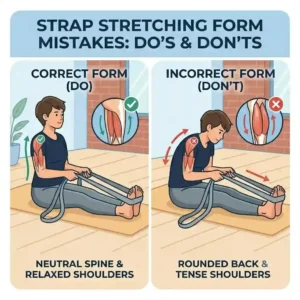
Solution: When lying on your back trying to pull your leg up, people often lift their head off the floor to reach the strap, causing cervical strain. The fix is to use a longer strap (like the 8-foot Vive) or thread your arms through the loops and use your body weight, rather than your bicep strength, to hold the tension. Let your shoulders melt into the floor.
Problem: Joint Pain Instead of Muscle Stretch
Solution: If you feel a sharp, pinching pain in the front of your hip or the back of your knee, you are compressing the joint capsule, not stretching the muscle. Slightly bend the knee (about 15 degrees) to take the tension off the sciatic nerve and joint ligaments, transferring the load directly into the belly of the hamstring muscle.
How to Choose a Stretching Exercise Strap That Actually Lasts
When evaluating mobility tools, the marketing hype is deafening. Look past the flashy packaging and evaluate these three critical criteria:
-
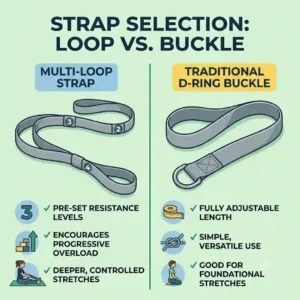
Loop Sizing and Spacing: The loops shouldn’t just be handles; they are measurement markers. Look for straps that have loops spaced every 6 to 8 inches. This allows for micro-progressions. If loops are too far apart, you can’t graduate your stretch smoothly. Furthermore, ensure the loops are at least 1.5 inches wide. Narrower loops will dig into the webbing of your fingers like wire.
-
Tensile Rigidity: For static stretching, elasticity is your enemy. If the strap has “give,” you cannot accurately measure your progress, and you lose the mechanical block required for isometric contractions. You want a strap that acts like an unyielding extension of your own arm.
-
Portability vs. Padding: Thicker, padded straps are luxurious but bulky. If you travel frequently for work and plan to use this in hotel rooms, a flat-woven nylon strap takes up zero space in a carry-on. If you solely practice at a home studio, prioritize neoprene or cotton comfort over packability.
Material Science: Nylon vs. Cotton Blends vs. Elastic
Understanding the engineering behind these fabrics will save you from making a purchase you’ll regret three months down the line.
Woven Nylon
Nylon is hydrophobic—it repels water and sweat. This makes it incredibly hygienic for gym environments where multiple people might use the same gear. It has an exceptionally high breaking point and zero stretch. The downside? The edges of the weave can be sharp. If you let a nylon strap slide rapidly through a sweaty palm, you will get a friction burn.
Poly-Cotton Blends
Cotton introduces softness, while the polyester matrix provides the strength to keep the strap from tearing. The biological interaction here is friction—cotton grips the skin and socks much better than slippery nylon, making it easier to hold a stretch without squeezing your hands to death. The hidden cost is hygiene; it acts as a sponge for dead skin and sweat, requiring a strict washing routine.
Why Not Elastic?
You might wonder why resistance bands aren’t on this list. Resistance bands (like Therabands) are for strengthening. When you try to stretch with a rubber band, the band absorbs the kinetic energy. As your muscle relaxes, the band shrinks. You never achieve a stable, fixed endpoint, which is required according to modern sports medicine flexibility guidelines to trigger the Golgi tendon organs to relax the muscle tissue.
Common Mistakes When Buying and Using Mobility Tools
What most buyers overlook about this category is that the tool is only as good as the intention behind its use. Here are the pitfalls to avoid:
Mistake 1: Chasing the “Burn”
More pain does not equal more flexibility. The spec sheet won’t tell you this, but human tissue responds to gentle, consistent remodeling, not aggressive tearing. If you are using the loops on your strap to yank your limb into agonizing positions, you are triggering a defensive inflammatory response. Less is more.
Mistake 2: Ignoring Asymmetry
Most people naturally favor their dominant side. They will hold a stretch on their right leg for a full minute, get bored, and hold the left leg for twenty seconds. A multi-loop strap actually helps fix this. You can count exactly which loop you hold on the right side and force yourself to reach the identical loop on the left side, quantifying your symmetry.
Mistake 3: Buying Solely on Price
While these tools are generally inexpensive, opting for a $5 generic strap over a $15 reputable brand is a mistake. Cheap straps use single-stitching on the loops. I have seen cheap loops snap under the load of a heavy leg press stretch, causing the user’s leg to violently drop, risking a groin tear. Look for box-X stitching on every loop connection.
✨ Don’t Miss These Exclusive Deals!
🔍 Ready to upgrade your recovery? Click on any highlighted item above to check current pricing and availability. The right tool makes the difference between chronic pain and fluid mobility!
Final Verdict
Navigating the world of mobility gear doesn’t have to be complicated, but it does require moving past the marketing fluff. A high-quality stretching exercise strap is fundamentally one of the highest ROI investments you can make for your physical health.
If you want clinical reliability, the OPTP remains undisputed. For daily comfort and living-room routines, the Tumaz poly-cotton blend is my definitive choice for 2026. Remember, flexibility isn’t about forcing your body into unnatural shapes; it’s about giving your nervous system the secure, leveraged support it needs to let go of chronic tension. Buy the right strap, respect your biomechanics, and consistency will take care of the rest.
FAQs
❓ What is the main benefit of a stretching exercise strap?
✅ It provides mechanical leverage, allowing you to achieve deeper, safer stretches independently. The rigid loops let you hold limbs in specific alignments without muscle fatigue in your arms, bypassing the body’s natural stretch reflex more effectively than unassisted stretching…
❓ Can I use a yoga strap instead of a looped stretching strap?
✅ Yes, but it requires more effort. Standard yoga straps use a single D-ring buckle, requiring you to adjust the size manually. Multi-loop straps allow instant micro-adjustments just by moving your hand to the next loop, maintaining the flow of your routine…
❓ How often should I use my mobility strap?
✅ For structural changes in tissue length, daily use is optimal. Brief, 10-minute sessions every day yield significantly better results than one brutal 60-minute session a week. Consistency signals to your nervous system that the new range of motion is safe to maintain…
❓ Should I stretch before or after my workout?
✅ Use your strap for dynamic, movement-based stretching before a workout to warm up joints. Save the deep, static holds (holding a position for 30-60 seconds) for after your workout when your muscles are fully warm and pliable…
❓ How do I clean a nylon stretching strap?
✅ Hand wash in cold water with a mild detergent or wipe down with antibacterial wipes. Avoid putting nylon straps in a high-heat dryer, as extreme heat can degrade the integrity of the synthetic fibers and weaken the structural stitching…
Recommended for You
- 7 Best Workout Straps with Handles to Maximize Your 2026 Gains
- 5 Best hip flexor exercises with resistance bands for 2026 Strength
- 5 Top Exercise Band Door Anchor Options Tested (2026 Guide)
Disclaimer: This article contains affiliate links. As an Amazon Associate, I earn from qualifying purchases. If you purchase products through these links, we may earn a small commission at no additional cost to you.
✨ Found this helpful? Share it with your friends! 💬🤗
[addtoany]
